


Before You Hire AI, Clean Your Kitchen: Why Most AI Projects Fail Before They Start
Key Points
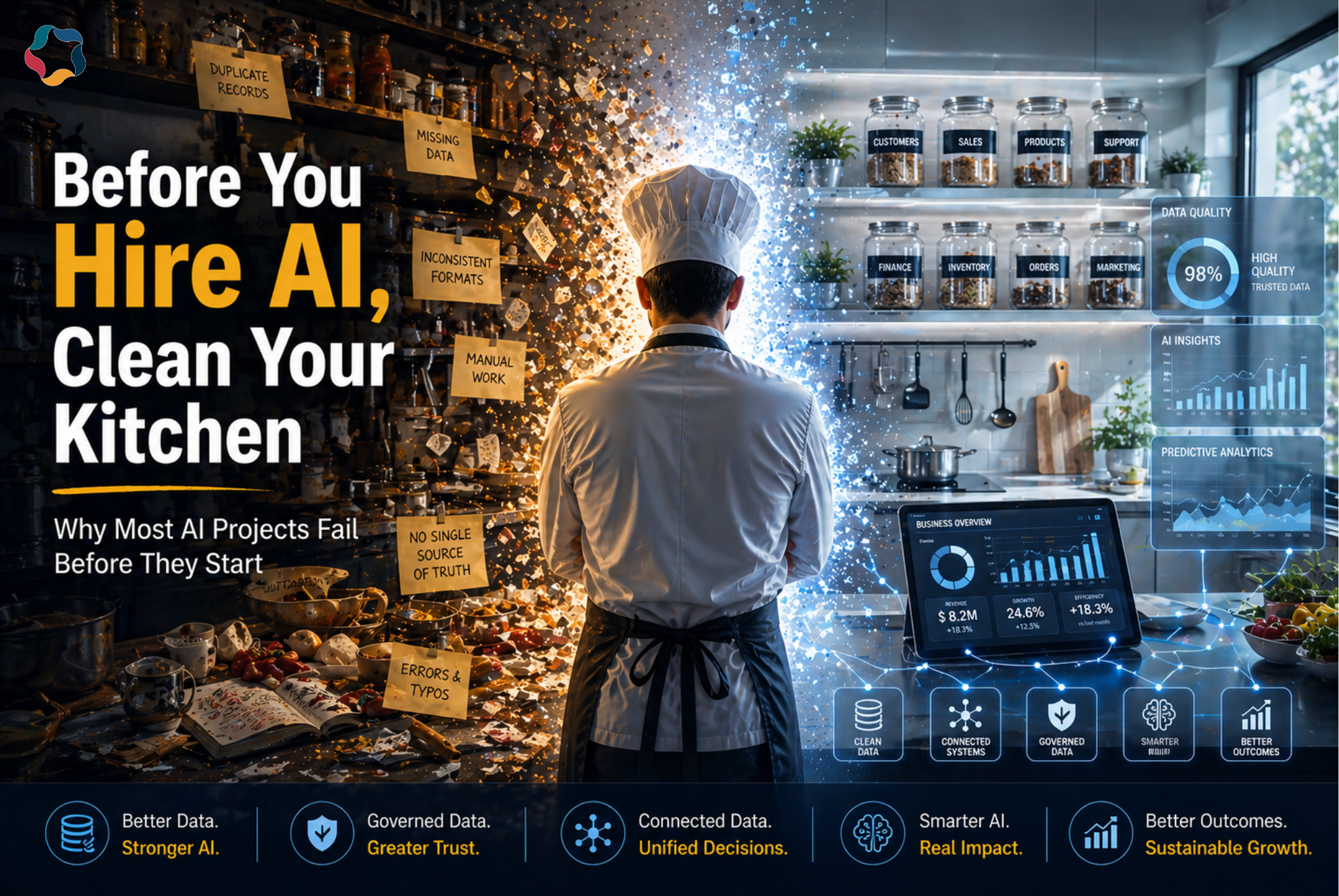
Imagine you have just hired the world’s best chef.
Michelin stars. Netflix specials. The works. You hand him the keys to your kitchen and say, “Cook me something incredible.”
He walks in… and freezes.
The flour is in three different jars, two of them unlabeled. Last month’s milk is hiding behind this morning’s milk. The salt and the sugar look identical. Some recipes are written on napkins. Others are stuck in a drawer no one can open.
The chef looks at you and asks one simple question:
How am I supposed to cook anything in here?
This is exactly what is happening with AI inside most companies today. 
The trillion-dollar misunderstanding
Every CEO I speak with wants the same thing: “Get us AI. Fast.”
So they buy the tools. Hire the consultants. Run the pilots.
And then… nothing happens.
Reports take just as long. Forecasts are still off. The chatbot gives weird answers. The “AI transformation” quietly turns into “the AI experiment” – and then into “remember when we tried that AI thing?”
According to recent research from McKinsey and the World Economic Forum, fewer than one in five organisations have managed to actually scale AI in any meaningful way. The blockers are not the AI models. The models are brilliant.
The blocker is the kitchen.
Or in business language: the data foundation.
What does “AI-ready data” actually mean? (No jargon, promise.)
Forget the buzzwords. Here is the simplest way to think about it.
Your company’s data – every customer record, every invoice, every email, every sales number – is the ingredient list for AI.
For AI to cook up something useful (a forecast, a recommendation, an answer, a decision), those ingredients need to be:
- Fresh. Not last quarter’s numbers pretending to be today’s.
- Labelled. So the AI knows what is salt and what is sugar – i.e., what is a “customer” vs a “lead” vs a “prospect.”
- In one place. Not scattered across 14 systems, 200 spreadsheets, and Karan-from-accounts’ personal laptop.
- Trusted. So when the AI gives you an answer, you actually believe it.
- Clean. No duplicates, no typos, no “John Smith” appearing six times as six different people.
That is it. That is the whole game.
When your data is in this shape, AI works. When it is not, AI fails – expensively, embarrassingly, and publicly.

The “Why Now” – and why it is no longer optional
For years, “messy data” was an IT problem. Annoying, but survivable. You could still run the business.
That window has closed. Here is why:
Old AI asked questions and you answered them. “Show me last month’s sales.”
Today’s AI takes actions on your behalf. It approves loans. It flags fraud. It writes proposals. It books meetings. It talks to your customers – as you.
Now ask yourself: would you let a brand-new employee make those decisions using your messy filing cabinet as their reference?
Of course not. So why would you let AI?
This is why the World Economic Forum recently called data readiness “a CEO and board-level responsibility” – not an IT one. The companies winning with AI in 2026 are not the ones with the fanciest models. They are the ones who quietly got their kitchen in order first.
The four signs your data is not ready (be honest)
A quick gut-check. How many of these sound familiar?
- The “Which number is right?” meeting.
Three people pull the same report. Three different numbers. An hour is spent figuring out whose Excel is correct.
- The “It lives in someone’s head” problem.
The only person who knows how customer data actually flows is Sunita – and Sunita is on leave.
- The “Spreadsheet bridge.”
Your fancy systems do not talk to each other, so an intern manually exports, pastes, and emails data between them every Tuesday.
- The “We have so much data, but…” sigh.
You have terabytes of data. You cannot answer a single useful business question with it.
If you nodded at even two of these, your AI investment is at risk. Not because AI does not work. Because the kitchen is not ready.
 What we actually do at Solution Analysts
This is the work that does not get the headlines – but it is the work that decides whether your AI succeeds or quietly dies.
Our Data Engineering & AI-Ready Data Foundation practice does four things, in plain English:
We clean the kitchen.
We find the duplicates, fix the typos, plug the gaps, and make sure last month’s milk gets thrown out.
We organise the pantry.
Every piece of data gets labelled, sorted, and placed where AI can find it in seconds – not weeks.
We connect the appliances.
Your CRM, your ERP, your billing system, your support tickets – they finally talk to each other in a single language.
We install the smoke alarms.
Governance, security, audit trails – so when a regulator (or your board) asks “where did this number come from?”, you have a real answer.
The result? Your AI projects stop stalling. Your reports stop disagreeing. Your team stops firefighting. And the chef can finally cook.
The honest closing thought
Here is what I tell every CEO who asks me, “Mehul, where do we start with AI?”
Don’t start with AI. Start with the data underneath it.
It is less exciting. It will not trend on LinkedIn. Your competitors will look like they are sprinting ahead with shiny demos.
But six months from now, when their pilots are quietly buried and yours is running the business – you will know exactly why.
The chef was never the problem. The kitchen was.
Let’s clean yours.
If you are wrestling with any of the four signs above, I would genuinely love to hear about it. Drop a comment, or reach out – even just to compare notes. The first conversation is always free.

Mehul Patel
Chief AI Officer
Mehul Patel is Chief AI Officer at Solution Analysts, where he leads AI strategy, innovation, and enterprise adoption initiatives. With 21+ years of experience, he has a proven track record of driving large-scale digital transformation programs and building high-performing global engineering teams.
His expertise spans agentic AI, enterprise platforms, and AI-driven automation across industries. Mehul is focused on enabling organizations to unlock tangible value from AI through structured strategy, robust engineering, and scalable execution.