


Unified Planning: Why Forecasting in Your Consolidation Tool Works
Key Points
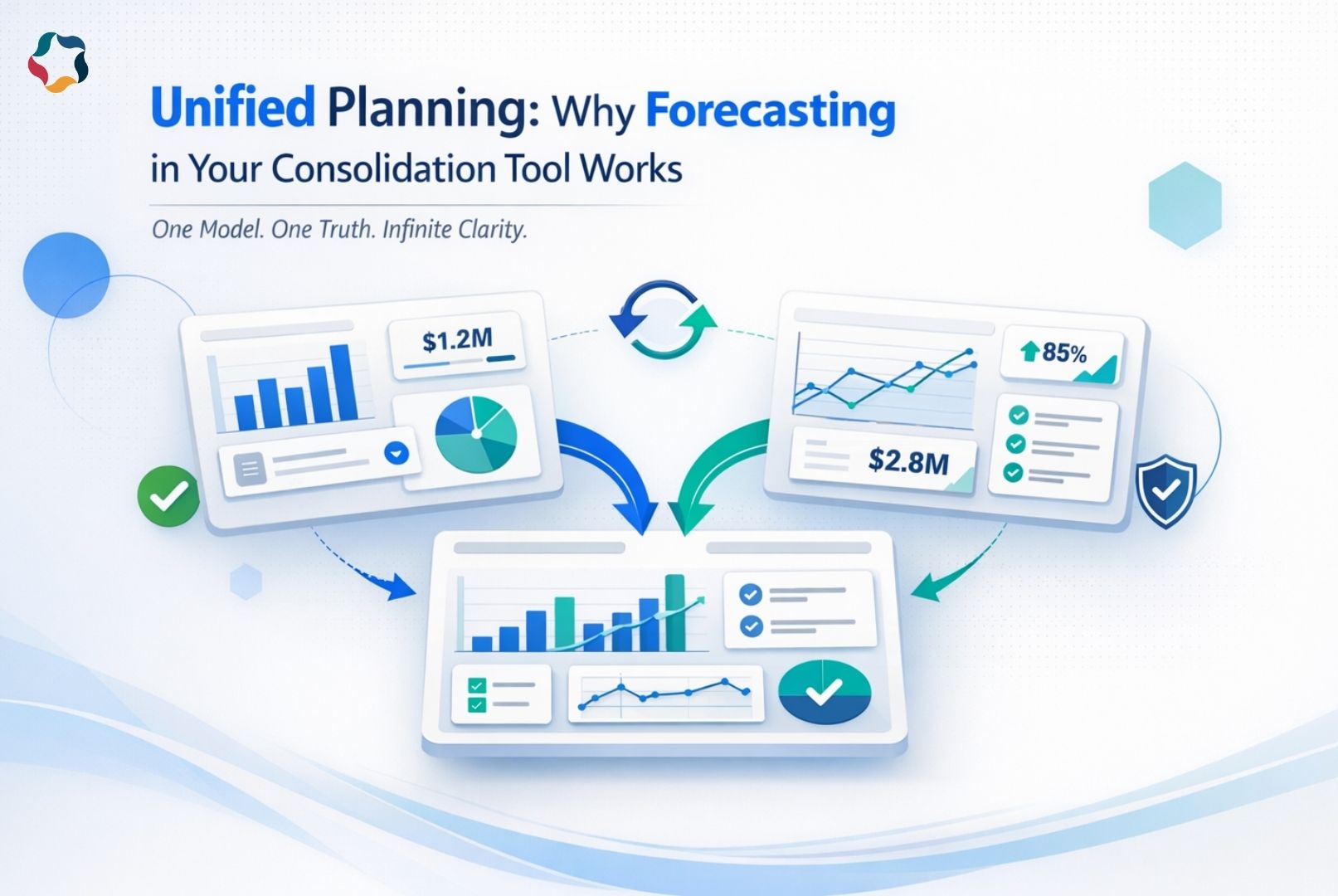
I take a clear position on this question: forecasting works best when it runs inside the same system that produces consolidated financial results. When planning models live outside the consolidation environment, finance teams inevitably spend time reconciling data, correcting assumptions, and explaining inconsistencies. In my experience, adopting unified planning consolidation software eliminates this friction by aligning forecasting, consolidation, and reporting around a single financial model.
Forecast credibility improves when planning and consolidation share the same financial model
I have seen many organizations maintain separate tools for forecasting and consolidation. While this approach appears flexible, it often creates structural reconciliation issues.
When forecasting operates within unified planning consolidation software, the same dimensions, account structures, and entity hierarchies drive both planning and consolidated reporting. Forecast assumptions therefore align naturally with financial results.
This alignment significantly improves forecast credibility. In environments where unified planning consolidation software governs both processes, finance teams no longer spend time validating whether forecast numbers reconcile with consolidated data.
Close discipline strengthens forecasting reliability
In every finance transformation I have observed, forecasting accuracy depends heavily on close discipline. If actual financial results arrive late or change frequently after consolidation, forecast models quickly become unreliable.
By using unified planning consolidation software, forecasting and consolidation share the same controlled dataset. When the close process completes, the forecast environment immediately reflects finalized results.
This tight integration allows FP&A teams to refresh forecasts faster and respond more quickly to business changes. In practice, organizations operating within unified planning consolidation software maintain stronger alignment between financial performance and forward-looking projections.
Governance improves when planning inherits consolidation controls
Financial consolidation systems typically enforce strong governance structures, including approval workflows, validation rules, and audit trails. Planning tools operating outside this framework often lack the same level of control.
When forecasting occurs inside unified planning consolidation software, the governance framework used for consolidation automatically extends to planning activities. Forecast submissions follow structured workflows, validation checks prevent inconsistent inputs, and changes remain fully auditable.
For organizations operating in regulated environments or complex entity structures, unified planning consolidation softwarek ensures that forecast numbers carry the same credibility as consolidated financial statements.
Operational complexity declines when planning and consolidation share infrastructure
Finance departments often maintain multiple disconnected tools for planning, consolidation, and reporting. Each system introduces its own data model, security rules, and integration processes.
Unified planning consolidation software reduces this complexity by consolidating planning and consolidation into a single platform. Instead of reconciling multiple systems, finance teams operate on a shared financial model.
The practical impact is significant. Organizations using unified planning consolidation software spend less time maintaining system integrations and more time analyzing financial performance.
Trade-offs require organizational discipline
Implementing unified planning consolidation software does introduce a trade-off. Finance teams must agree on standardized structures for accounts, entities, and planning models. Organizations accustomed to decentralized planning processes may initially find this discipline restrictive.
However, in my experience, this standardization ultimately strengthens financial governance and reduces operational complexity.
Conclusion
My conclusion is straightforward: forecasting works best when it operates inside the consolidation system that defines financial truth. Unified planning consolidation software aligns planning, consolidation, and reporting around a single governed financial model.
Organizations adopting unified planning consolidation software eliminate reconciliation friction, improve forecast credibility, and strengthen governance across finance operations. For CFOs, FP&A leaders, and EPM architects, this approach represents more than a system change—it represents a more coherent and reliable financial operating model.


Sameer Pota
Project Manager
Sameer Pota is a Project Manager at Solution Analysts, recognized for effectively managing timelines, resources, and stakeholder communication. As a OneStream expert, he oversees client implementations, ensures seamless project delivery, and mentors developers to maintain best practices and deliver high-quality financial solutions.