


Legacy EPM vs. OneStream: 2026 Decision Matrix
Key Points
Introduction
In 2026, I see Enterprise Performance Management (EPM) at a critical inflection point. Organizations that once relied heavily on legacy EPM platforms are now reassessing their long-term suitability in a business environment driven by real-time insights, automation, scalability, and integrated planning. Finance leaders I work with are under increasing pressure to reduce system complexity, lower total cost of ownership, and improve agility while still maintaining strong governance and auditability.
This pressure has led to an industry-wide evaluation commonly framed as OneStream vs Hyperion. From my perspective, the OneStream vs Hyperion discussion is no longer just a technical comparison. It has become a strategic decision matrix that directly influences finance transformation, digital maturity, and long-term competitiveness. In this blog, I provide a comprehensive analysis of legacy EPM systems versus OneStream to help decision-makers navigate the 2026 EPM landscape with clarity and confidence.
Understanding Legacy EPM Platforms
Legacy EPM platforms such as Oracle Hyperion were designed in an era when finance processes were largely siloed. In those environments, planning, consolidation, account reconciliation, reporting, and analytics often required separate modules, databases, and tools. While these systems were market leaders for many years, I believe their architecture reflects assumptions that no longer align with modern enterprise needs.
In the context of OneStream vs Hyperion, I typically see legacy systems relying on multiple products for planning, consolidation, and reporting, heavy IT dependency for maintenance and upgrades, complex data integrations and batch-based processing, higher infrastructure and licensing costs, and limited extensibility without custom development.
Although Hyperion remains functional in many organizations, I increasingly hear concerns from CFOs and CIOs about its long-term roadmap and rising operational overhead.
The Rise of OneStream as a Unified EPM Platform
OneStream emerged with a fundamentally different philosophy that I find compelling: unify all core EPM processes on a single platform, a single data model, and a single application. Instead of stitching together multiple tools, OneStream provides an integrated solution covering financial consolidation, planning, forecasting, reporting, analytics, and data management.
In the OneStream vs Hyperion debate, I often see OneStream positioned as a modern alternative built for scalability and extensibility. Its adoption has accelerated because it directly addresses many of the pain points I encounter in legacy EPM environments.
From my experience, key characteristics of OneStream include a single application supporting multiple EPM processes, unified metadata and dimensionality, built-in data integration and workflow, an extensible architecture through the OneStream MarketPlace, and strong governance and audit capabilities.
Architectural Comparison: Legacy EPM vs OneStream
Architecture is one of the most decisive factors in any OneStream vs Hyperion evaluation.
Hyperion architecture typically involves separate cubes for Planning, HFM, Essbase, and Reporting. Each component has its own metadata, security model, and maintenance requirements. In practice, I see this increase complexity, introduce reconciliation challenges, and slow down change cycles.
OneStream, by contrast, uses a single extensible dimensional model. Financial and operational data coexist within the same framework, enabling consistency across planning, consolidation, and reporting. In my experience, this architectural simplicity translates directly into reduced maintenance effort and faster time-to-value.
Looking at 2026 requirements, I see enterprises increasingly favoring platforms that support cloud scalability, frequent updates, and lower technical debt. In this context, OneStream vs Hyperion comparisons consistently highlight OneStream’s architectural advantage.
Functional Coverage and Process Integration
Legacy EPM systems often perform well in specific functional areas but struggle to deliver seamless end-to-end process integration. For example, I have seen Hyperion Financial Management handle consolidations effectively, but integrating it smoothly with planning, account reconciliations, and analytics often requires additional tools and workarounds.
In my OneStream vs Hyperion analysis, OneStream stands out because of its integrated functional coverage. Planning, forecasting, consolidation, journal management, account reconciliations, and reporting all operate within a single workflow. This reduces manual handoffs and minimizes reconciliation issues between systems.
I have also observed that integrated workflow and process monitoring in OneStream improves accountability and transparency. Finance teams gain real-time visibility into task status, bottlenecks, and data readiness, which is increasingly critical in fast-paced reporting cycles.
Total Cost of Ownership in 2026
Cost considerations remain central to the OneStream vs Hyperion decision matrix. While legacy systems are often viewed as “sunk cost” solutions, I find that ongoing expenses tell a very different story.
In Hyperion environments, I commonly see high infrastructure and database costs, separate licenses for multiple modules, reliance on specialized skills for administration and support, and higher upgrade and patching effort.
OneStream’s unified platform reduces infrastructure duplication and administrative overhead. Cloud deployment options further lower capital expenditure and simplify scalability. Over a five-to-seven-year horizon, many organizations I work with find that OneStream delivers a lower total cost of ownership compared to maintaining and extending legacy EPM platforms.
This financial reality is a major driver behind ongoing OneStream vs Hyperion replacement programs.
User Experience and Adoption
User adoption is a critical success factor in any EPM implementation. Legacy EPM tools often suffer from complex user interfaces and inconsistent experiences across modules. Training requirements are high, and business users frequently depend on IT for even small changes.
In the OneStream vs Hyperion comparison, I find that OneStream offers a more consistent and modern user experience. A single interface supports multiple processes, reducing the learning curve for finance users. Guided workflows, dashboards, and drill-down capabilities improve productivity and decision-making.
By 2026, finance teams increasingly expect self-service capabilities. In my view, OneStream aligns well with this expectation by enabling controlled flexibility without compromising governance.
Extensibility and Future Readiness
One of the key limitations I see in legacy EPM platforms is extensibility. Custom requirements often require bespoke development, which increases technical debt and upgrade risk.
OneStream addresses this challenge through its extensible platform and MarketPlace solutions. Pre-built business rules, dashboards, and integrations can be deployed without modifying the core application. I see this approach supporting innovation while preserving system stability.
In the OneStream vs Hyperion context, future readiness is often decisive. Organizations want EPM platforms that can adapt to regulatory changes, new business models, and advanced analytics such as predictive forecasting and AI-driven insights.
Data Management and Governance
Data integrity and governance are foundational to EPM success. In legacy environments, I often see heavy reliance on external ETL tools and manual controls to manage data quality.
OneStream includes native data integration, transformation, and validation capabilities. Finance teams can define business rules and data quality checks directly within the platform. When I evaluate OneStream vs Hyperion, governance capabilities consistently emerge as a strength of OneStream, particularly in highly regulated industries.
Migration Considerations
I recognize that transitioning from legacy EPM systems is not without challenges. Data migration, process redesign, and change management require careful planning.
That said, many organizations I work with adopt a phased approach in the OneStream vs Hyperion journey. Initial implementations often focus on consolidation and reporting, followed by planning and operational use cases. With experienced implementation partners and a structured roadmap, migration risks can be effectively managed while delivering incremental value.
Strategic Decision Matrix for 2026
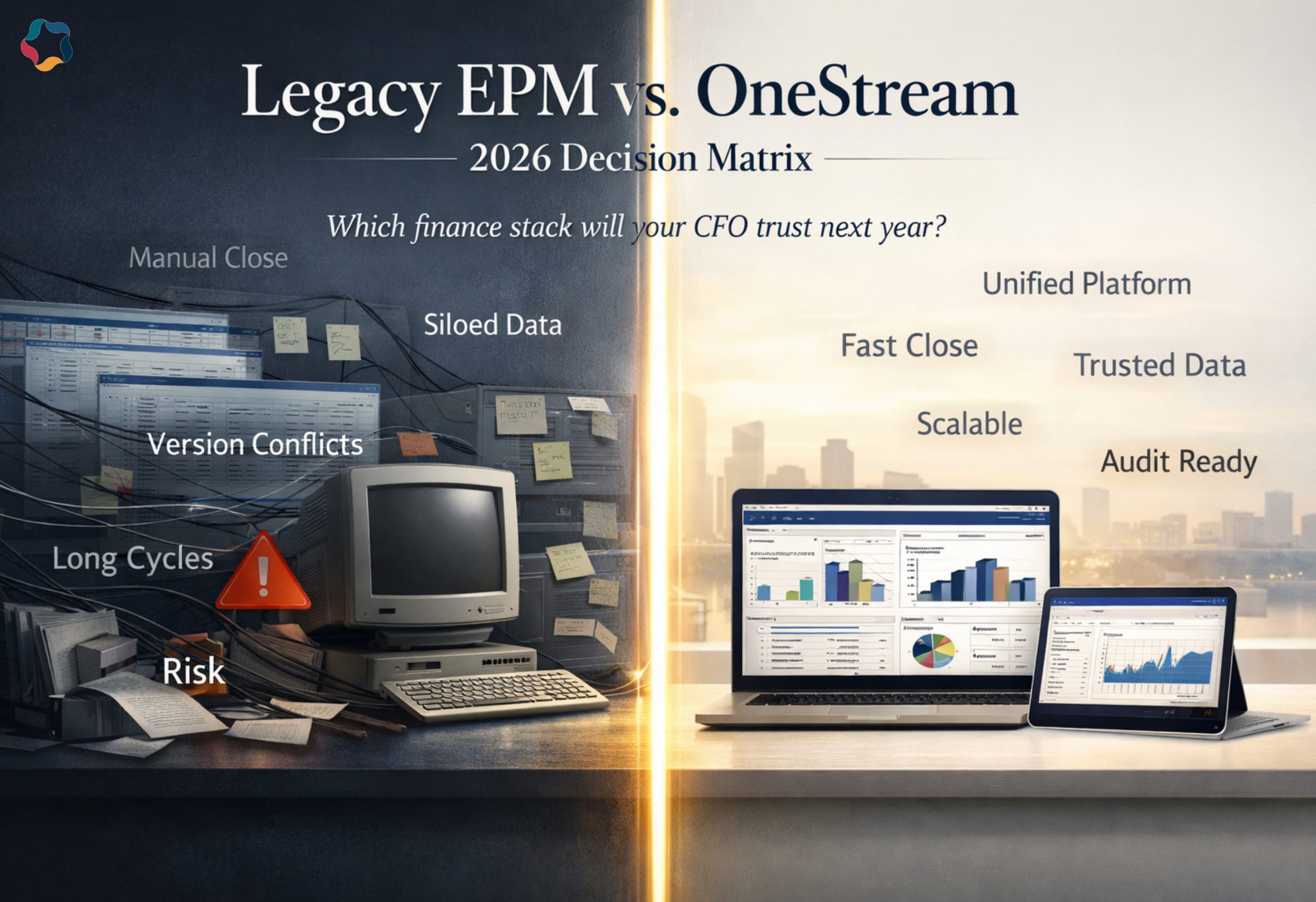
From my perspective, the 2026 decision matrix for Legacy EPM vs OneStream typically evaluates architectural simplicity, functional integration, cost efficiency, user experience, extensibility, governance and compliance, and the long-term vendor roadmap.
Across these dimensions, I consistently see OneStream vs Hyperion assessments favoring OneStream, especially for organizations seeking true modernization rather than incremental optimization.
Conclusion
As enterprises look toward 2026 and beyond, I believe the limitations of legacy EPM platforms are becoming increasingly evident. While Hyperion and similar tools played a vital role in the evolution of enterprise finance, their fragmented architectures and rising costs now pose strategic challenges.
Ultimately, the OneStream vs Hyperion decision is about future readiness. From my experience, OneStream’s unified architecture, integrated functionality, lower total cost of ownership, and strong governance position it as a compelling choice for organizations embarking on finance transformation.
For CFOs, finance leaders, and IT decision-makers, evaluating Legacy EPM vs OneStream through a structured 2026 decision matrix provides clarity and direction. In an environment where agility, accuracy, and insight are paramount, I see OneStream not just as a technology upgrade but as a strategic enabler for modern finance.


Sameer Pota
Project Manager
Sameer Pota is a Project Manager at Solution Analysts, recognized for effectively managing timelines, resources, and stakeholder communication. As a OneStream expert, he oversees client implementations, ensures seamless project delivery, and mentors developers to maintain best practices and deliver high-quality financial solutions.