


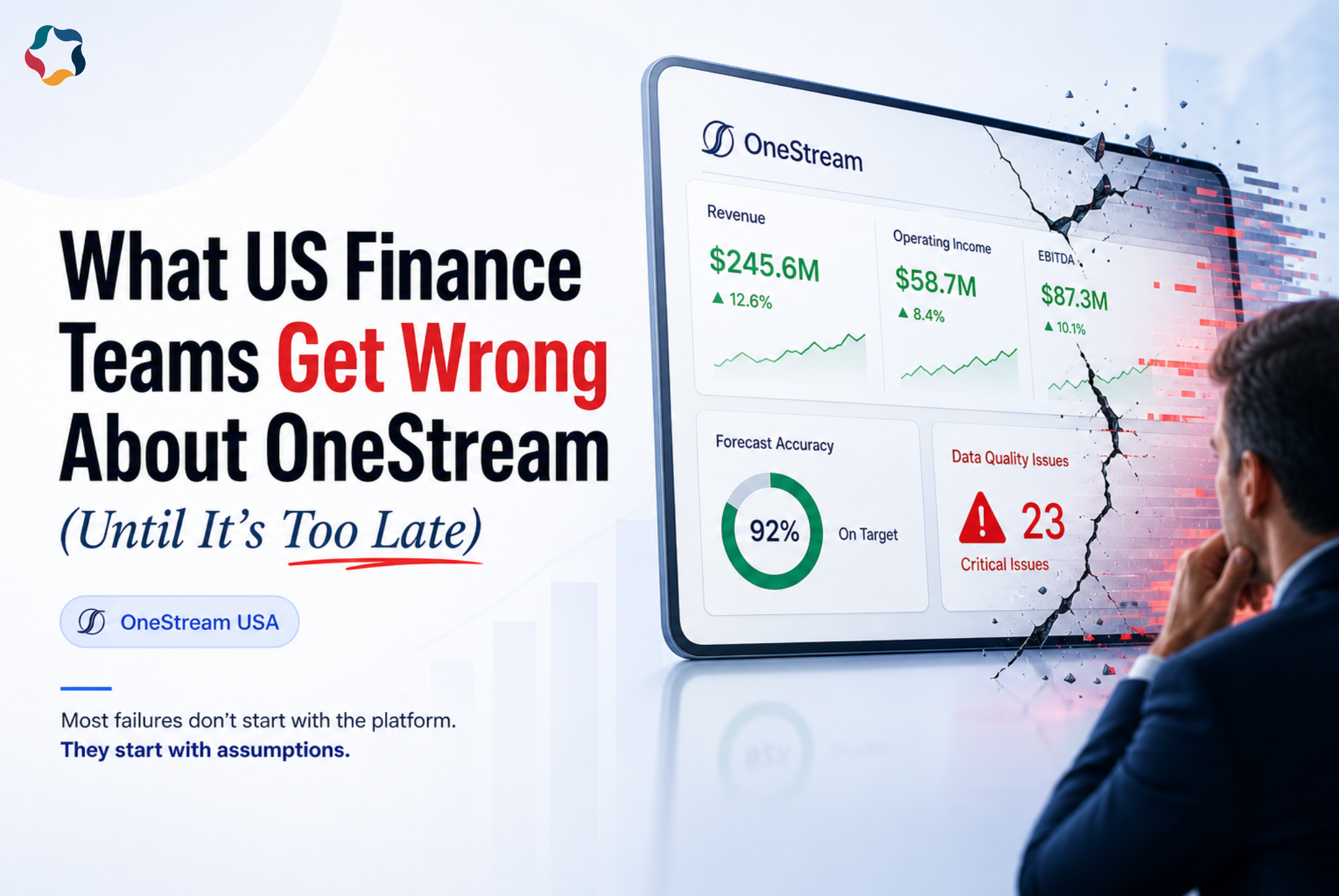
What US Finance Teams Get Wrong About OneStream (Until It’s Too Late)
Key Points
What US Finance Teams Get Wrong About OneStream (Until It’s Too Late)
(It’s not the software. It’s how each team expects it to work and adopt it.)
Most teams don’t realize they got OneStream wrong…
…until they’re already live.
A Real Situation (Everyone Has Been Here)
You’re in a leadership meeting.
The CFO asks:
“What’s our exposure if margins drop 3% next quarter?”
Everyone turns to finance.
- FP&A checks models
- Controllers think about consolidation impact
- IT wonders where the data lives
And the answer is:
“We’ll need some time to run that.”
You just implemented OneStream.
So why is this still happening?
So why is this still happening?
The Problem Looks Different to Each Stakeholder
Across many OneStream USA implementations, each team assumes the system will solve their problem.
But no one aligns on how it should work together — or how teams will adopt it.
Stakeholder Reality + Adoption Gap
CFO Perspective
“Why don’t I have real-time insight yet?”
Expectation
- Instant visibility
- Scenario answers during meetings
Reality
- Faster data, but still waiting on teams
- Limited real-time decision support
Adoption Gap
- CFOs expect output, but don’t drive process change across teams
What Works
- Define decision timelines (e.g., “scenario in <2 hours”)
- Push for cross-functional accountability
Controller Perspective
“Close improved, but effort hasn’t reduced as expected.”
Expectation
- Clean consolidation
- Reduced manual adjustments
Reality
- Data still needs validation
- Some legacy logic persists
Adoption Gap
- Controllers replicate old processes inside new system
What Works
- Redesign close workflows (not copy them)
- Standardize ownership and data rules
FP&A Perspective
“I still need Excel to answer real questions.”
Expectation
- Flexible forecasting
- Quick scenario modeling
Reality
- Models exist but lack usability
- Scenario building still slow
Adoption Gap
- Teams trust Excel more than system logic
What Works
- Build usable, business-driven models
- Train teams on scenario workflows, not just tools
IT Perspective
“We simplified architecture — but demand increased.”
Expectation
- Fewer systems
- Lower maintenance
Reality
- More demand for real-time data
- Continuous enhancement requests
Adoption Gap
- IT focuses on delivery, not long-term enablement
What Works
- Treat OneStream as a platform, not a project
- Establish ongoing governance model
Business/User Perspective
“It looks powerful… but I still rely on reports.”
Expectation
- Self-service insights
- Easy access to data
Reality
- Learning curve slows adoption
- Reports still dominate decisions
Adoption Gap
- Users not trained in how to use insights
What Works
- Role-based training
- Use real business scenarios (not generic demos)
Where Misalignment + Adoption Break Down
|
Stakeholder
|
Expectation
|
Reality
|
Adoption Gap
|
|---|---|---|---|
|
CFO
|
Real-time insight
|
Faster, not instant
|
No cross-team enforcement
|
|
Controller
|
Clean consolidation
|
Improved, still controlled
|
Old processes retained
|
|
FP&A
|
Agile planning
|
Better, not flexible enough
|
Excel dependency
|
|
IT
|
Simpler systems
|
Simpler, but more demand
|
No platform mindset
|
|
Business
|
Self-service
|
Partial usage
|
Low adoption confidence
|
The Root Cause
It’s not implementation.
It’s this:
– Each team optimizes for itself
– No one aligns on how finance decisions should happen end-to-end
– No one aligns on how finance decisions should happen end-to-end
And more importantly:
– No one plans how teams will adopt new ways of working
What Successful OneStream USA Teams Do Differently
They don’t start with:
- Modules
- Reports
- Replicating current state
They start with:
“How should a decision happen – in real time?”
Then they align:
- Process
- Data
- Ownership
- Adoption
And configure OneStream to support that.
What Actually Changes When Done Right
- CFOs get answers during meetings
- Controllers trust data without over-validation
- FP&A responds instead of rebuilding
- IT enables, not reacts
- Business users engage with insights
Conclusion
OneStream doesn’t fail organizations.
But organizations fail when they:
❌ Implement the system
❌ But don’t change how teams work
❌ But don’t change how teams work
The real question isn’t:
- “Did we implement OneStream?”
It’s:
- “Did our teams actually adopt a new way of operating?”
Because that’s the difference between:
- having a system
and
- running a decision-ready finance function

Viren Patel
Managing partner USA
Viren Patel is Managing Partner in USA at Solution Analysts, driving North America growth through OneStream EPM sales, implementation, and account management for CFO and FP&A leaders. Patent-holder, award-recognized leader with 23+ years of experience delivering enterprise performance management, financial consolidation, planning, and analytics solutions.