


OneStream Task Manager – Beyond the Basics
Key Points
Introduction
My position is simple: if your OneStream Task Manager workflow is only being used to track “done vs not done,” you are leaving operational control, accountability, and decision velocity on the table. At scale, Task Manager is not a checklist it is the control plane of the finance operating model. Used properly, it determines whether close cycles compress or sprawl, whether planning is governed or improvised, and whether ownership is real or cosmetic.
I am not arguing that every OneStream customer should make Task Manager the centre of the universe. I am arguing that for enterprise finance teams running complex planning, consolidation, forecasting, and controls processes, a mature OneStream task manager workflow becomes the difference between a system that supports finance and one that quietly undermines it.
An OneStream Task Manager Workflow Is a Control System, not a Scheduling Tool
The biggest mistake I see is treating Task Manager like a calendar with checkboxes. That framing is fundamentally wrong. An OneStream task manager workflow is a process control system one that enforces sequencing, ownership, dependency logic, and auditability across financial processes.
In real-world close cycles, the risk is not that tasks exist; it’s that tasks complete in the wrong order, without prerequisite data readiness, or without accountability for delay. When Task Manager is configured beyond the basics—using predecessor logic, workflow integration, and status-driven controls it actively prevents downstream execution until upstream conditions are met.
In consolidation, this matters more than anywhere else. Entity data loads, intercompany eliminations, FX translations, and consolidation runs are not independent activities. A properly designed OneStream task manager workflow encodes this dependency structure directly into execution, rather than relying on tribal knowledge or email escalation. The result is fewer re-runs, fewer “who changed what” debates, and a close that behaves deterministically instead of emotionally.
Ownership in Task Manager Only Works When It Mirrors the Operating Model
Assigning tasks is easy. Assigning ownership is not.
The difference is whether the OneStream task manager workflow mirrors how finance actually operates—or how leadership wishes it did. I have seen implementations where Task Manager was technically complete but operationally irrelevant because task ownership did not reflect decision rights, regional accountability, or functional separation.
In planning cycles, this failure is especially visible. When forecast updates, driver refreshes, and scenario approvals are owned by roles rather than real decision-makers, Task Manager becomes performative. Tasks are “completed” while assumptions remain unresolved.
The most effective OneStream task manager workflow designs I’ve seen align tasks to control owners, not just executors. A forecast sign-off task owned by FP&A leadership carries weight; the same task owned by a generic planning user does not. This distinction is uncomfortable, but necessary. Task Manager exposes weak governance faster than any dashboard.
Dependency Logic Is Where Task Manager Either Pays Off or Collapses
If I had to pick one capability that separates basic usage from mature usage, it’s dependency logic.
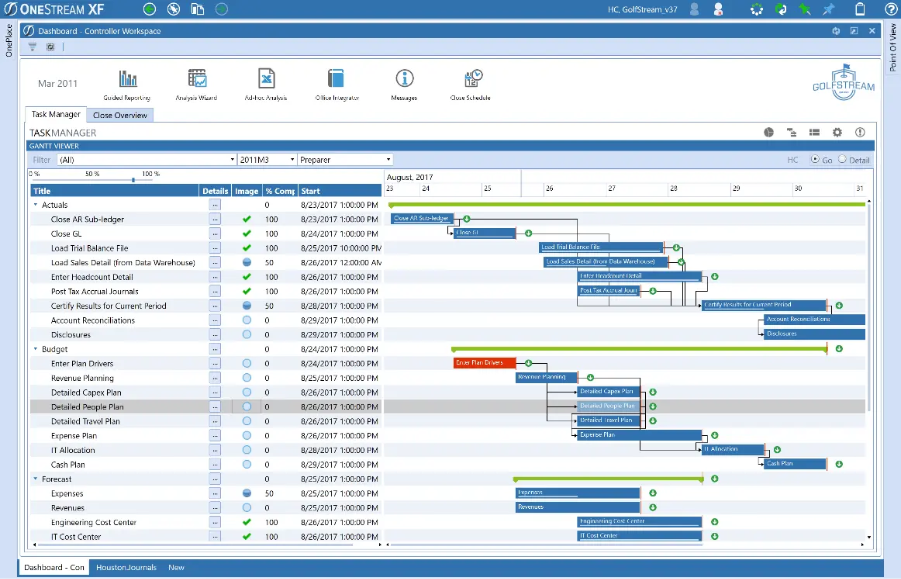
A OneStream task manager workflow without meaningful predecessors is little more than a task list. The moment you encode real dependencies—data load completion, workflow status changes, calculation runs—you turn Task Manager into a live process engine.
In consolidation, this is transformational. For example:
- Local entity certification tasks cannot complete until workflow is promoted.
- Consolidation runs cannot execute until all required entities are certified.
- Reporting tasks remain locked until consolidation status is green.
This is not about control for control’s sake. It’s about eliminating false progress. When teams stop seeing tasks as independent and start experiencing them as a chain, behavior changes. Escalations become targeted. Bottlenecks become visible. The OneStream task manager workflow stops being polite and starts being honest.
Task Manager Becomes Strategic When It Connects to Workflow Status
The real power of the OneStream task manager workflow shows up when Task Manager and OneStream Workflow are not treated as separate modules.
When task completion is driven by workflow status—rather than manual user clicks—you remove subjectivity from progress reporting. A task completes because data is certified, not because someone says it is. This matters enormously in regulated environments and SOX-controlled processes.
In practice, this means fewer “green but not really” closes. It also means fewer arguments between central finance and regions about readiness. The system becomes the referee. Finance leaders don’t have to interrogate status; they can trust it.
This integration is uncomfortable for teams accustomed to flexibility. But flexibility is often just another word for ambiguity. A mature OneStream task manager workflow replaces ambiguity with clarity, and clarity always feels strict before it feels freeing.
Planning and Forecasting Benefit More Than Close If You Let Them
Most organizations invest heavily in Task Manager for close, then underuse it for planning and forecasting. That’s a mistake.
Planning processes fail not because of missing models, but because of uncontrolled iteration. Assumptions change late. Inputs drift. Reviews happen out of sequence. A well-designed OneStream task manager workflow brings discipline without killing agility.
For example:
- Driver input tasks open only when prior actuals are locked.
- Scenario refresh tasks trigger automatically after data loads.
- Review and approval tasks are enforced before forecast promotion.
The key is resisting the temptation to over-automate judgment. Task Manager should govern when decisions happen, not what decisions are made. When that boundary is respected, planning cycles become faster precisely because they are more constrained.
There Are Real Trade-offs and Ignoring Them Backfires
Let’s be clear: a heavily enforced OneStream task manager workflow is not free.
The biggest trade-off is changing resistance. Teams accustomed to informal coordination will push back. They will call it rigid. They will ask for exceptions. If leadership caves too early, Task Manager becomes decorative.
Another risk is over-engineering. I have seen workflows so complex that maintaining them became a full-time job. When every exception requires administrative intervention, velocity drops. A mature design accepts that not every edge case deserves automation.
The rule I follow is simple: automate control points, not creativity. Use Task Manager to enforce sequence, ownership, and readiness but leave analytical judgment where it belongs, with people.
Conclusion
My view is unapologetic: a serious OneStream task manager workflow is a governance decision, not a technical one. It forces clarity around ownership, sequencing, and accountability that many finance organizations claim to want but quietly avoid.
For CFOs, FP&A leaders, and EPM architects, the implication is uncomfortable but powerful. If your processes cannot survive being encoded into Task Manager, the problem is not OneStream. It is the operating model itself.
Used beyond the basics, OneStream Task Manager does not just organize work it reveals how finance truly runs. And once that reality is visible, leaders can finally decide whether to accept it or change it.
Reference:


Darshakkumar Prajapati
Lead Engineer
Darshak is a Lead Software Development Engineer with strong expertise in OneStream, including Cube Views, Dashboards, Business Rules, and advanced reporting solutions. He has 7+ years of experience delivering scalable enterprise applications across diverse domains.Specializing in Node.js, JavaScript, Angular, and DevOps, Darshak brings robust debugging and problem-solving skills to every project. Passionate about knowledge sharing, he actively contributes insights and best practices to the broader developer community.