


How OneStream Replaces Multiple Finance Tools with a Single Platform?
Key Points
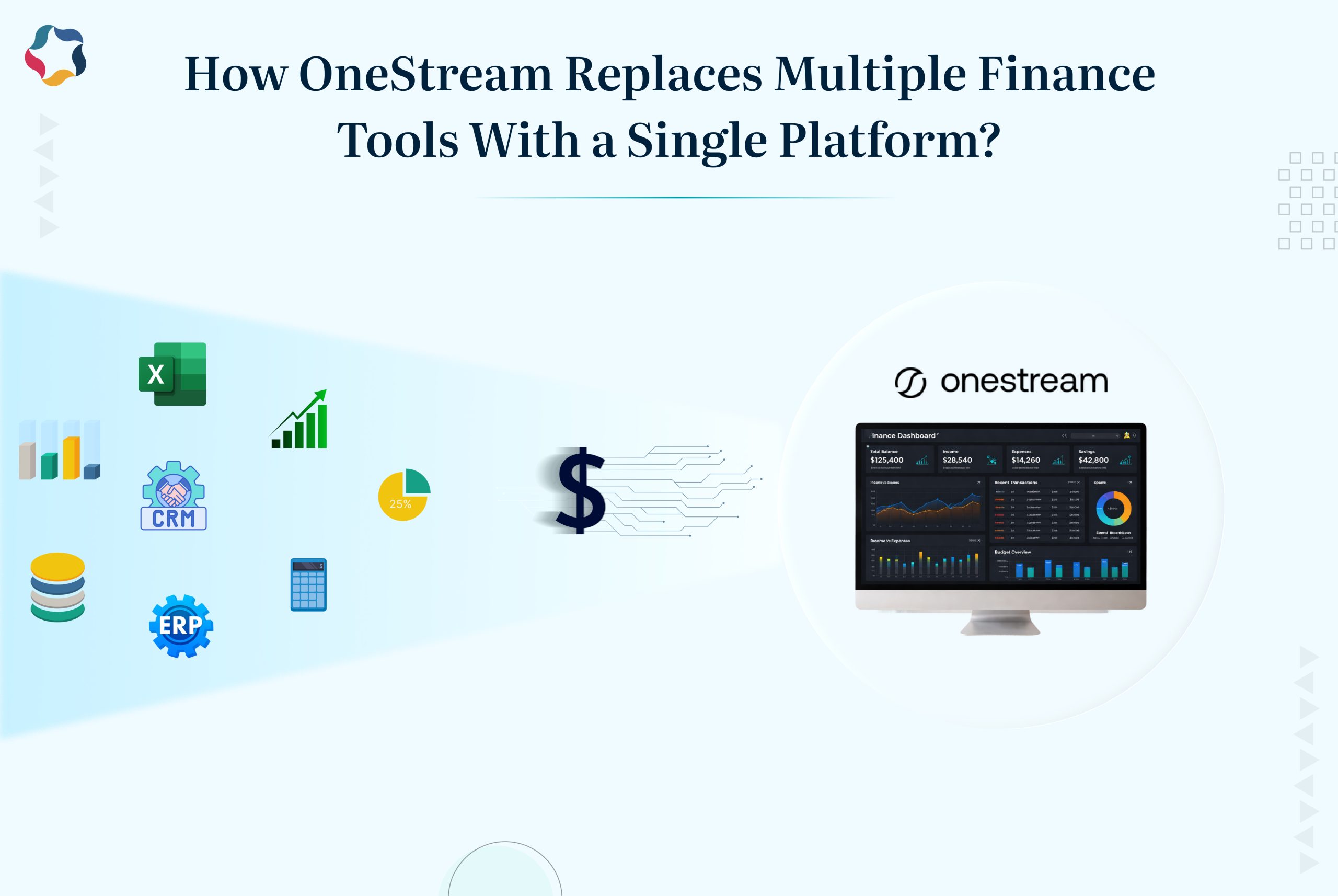
If you’re still stitching together consolidation, planning, reporting, and data integration across multiple tools, you’re not running a finance platform, you’re managing a fragile ecosystem. My view is simple: the real value of OneStream platform benefits is not featuring depth, but architectural elimination of fragmentation.
The Real Problem Isn’t Tool Capability, It’s Tool Fragmentation
In most enterprises I’ve worked with, the issue was never that consolidation tools couldn’t consolidate or that planning tools couldn’t plan. The issue was that each tool solved its own problem well but collectively created systemic inefficiencies.
You end up with:
- Separate data models for consolidation vs planning
- Reconciliation layers between actuals and forecasts
- Multiple calculation engines producing slightly different numbers
- Heavy IT dependency just to keep integrations alive
This is where OneStream platform benefits become fundamentally different. It doesn’t try to be “better” at each individual function, it removes the need to reconcile between them.
That architectural shift is the real value.
A Single Data Model Eliminates Reconciliation as a Process
The most immediate impact I’ve seen is on reconciliation.
In traditional setups:
- Consolidation runs on one cube
- Planning runs on another
- Actual vs forecast comparisons require mapping layers
In OneStream, everything sits on a single extensible data model.
That means:
- Actuals, budgets, forecasts, and scenarios share the same dimensional structure
- No data movement is required to compare scenarios
- Variance analysis becomes native, not engineered
This is one of the most practical OneStream platform benefits—you eliminate entire categories of reconciliation work rather than optimizing them.
From an architecture standpoint, this also simplifies governance. You’re not validating multiple systems—you’re validating one source of truth.
Finance Logic Moves from Spreadsheets to Controlled Rules
One pattern I consistently see is business logic living in Excel.
With OneStream:
- Business rules are embedded directly into the platform
- Calculations are version-controlled
- Logic executes consistently across scenarios
This changes how finance operates.
Instead of: “Let me adjust this in Excel and upload again”
You move to: “The rule already handles this across all entities and scenarios”
That’s a significant operational shift and one of the more underappreciated OneStream platform benefits.
It reduces key-person dependency and increases auditability without slowing down finance teams.
Planning and Consolidation Finally Share the Same Reality
Most organizations claim to have “integrated planning and consolidation.” In reality, they have connected systems.
There’s a difference.
Connected systems:
- Exchange data
- Require alignment processes
- Still drift over time
Unified systems:
- Operate on the same data
- Use the same logic
- Cannot diverge structurally
This is where OneStream fundamentally changes the model.
Planning isn’t an extension, it’s part of the same platform:
- Driver-based planning uses actuals without transformation
- Forecasts update immediately against consolidated results
- Scenario comparisons are native
This alignment is one of the strongest OneStream platform benefits, especially for FP&A teams who spend too much time validating numbers instead of analyzing them.
Close Process Becomes Shorter Because Dependencies Disappear
Most finance teams try to accelerate close by optimizing tasks:
- Faster data loads
- Parallel processing
- Workflow automation
But the real bottleneck is dependency between systems.
When consolidation, adjustments, and reporting live in different tools:
- Each step waits for the previous system
- Errors cascade across systems
- Late changes require reprocessing everywhere
With a unified platform:
- Adjustments, consolidations, and reporting happen within the same system
- No cross-system dependencies exist
- Late adjustments don’t break downstream processes
This is a structural improvement, not an efficiency gain.
And it’s one of the most tangible OneStream platform benefits when measured in close cycle days.
Extensibility Replaces Custom Tool Proliferation
Another pattern I’ve seen is tool sprawl driven by edge use cases:
- A separate system for account reconciliations
- Another for tax provisioning
- Another for profitability analysis
Over time, finance architecture becomes a collection of specialized tools.
OneStream takes a different approach:
- Extensible dimensionality (UD1–UD8)
- Configurable workflows
- Custom solutions built within the same platform
This allows organizations to bring additional processes into the same ecosystem without introducing new tools.
However, this is where a trade-off emerges.
The Trade-Off: Flexibility Requires Strong Architecture Discipline
Let’s be clear—OneStream platform benefits don’t come without responsibility.
Because the platform is flexible:
- Poor dimensional design can create long-term issues
- Overuse of business rules can impact performance
- Lack of governance can lead to inconsistent implementations
I’ve seen implementations where:
- UD dimensions were misused for unrelated purposes
- Rules became overly complex and hard to maintain
- Performance degraded due to design decisions, not platform limits
In a multi-tool environment, poor design is isolated.
In a unified platform, poor design is amplified.
That’s the trade-off:
You gain architectural simplicity—but you must design it correctly from the start.
IT Dependency Shifts—It Doesn’t Disappear
Another misconception is that OneStream reduces IT involvement entirely.
It doesn’t.
What it does is change the nature of IT dependency:
- Less time spent on integrations
- More time spent on platform governance and optimization
Finance teams gain more control, but:
- Platform ownership becomes critical
- Change management must be structured
- Release cycles need discipline
This is still a net positive—and a key part of OneStream platform benefits—but it requires organizational maturity.
Cloud Deployment Removes Infrastructure as a Constraint
With deployments on platforms like Azure, infrastructure becomes less of a bottleneck.
You no longer worry about:
- Hardware sizing for peak consolidation
- Maintenance windows for upgrades
- Environment inconsistencies
Instead:
- Scalability is handled at the platform level
- Performance tuning focuses on application design
- Upgrades are more controlled and predictable
This reinforces the core value proposition of OneStream platform benefits—not just unification of tools, but simplification of the entire finance technology stack.
The Real Outcome: Finance Stops Managing Systems
When OneStream is implemented correctly, something subtle but important happens.
Finance teams stop thinking in terms of systems:
- No more “Which system has the correct number?”
- No more reconciliation cycles across tools
- No more workaround spreadsheets
Instead, they operate within a single environment:
- Data, logic, and reporting are aligned
- Processes are integrated, not coordinated
- Insights come faster because validation work disappears
This is the practical impact of OneStream platform benefits—not just efficiency, but clarity.
Conclusion: OneStream Is a Strategic Simplification, Not Just a Tool Replacement
I don’t see OneStream as a better consolidation tool or a better planning tool. I see it as a decision to eliminate the multi-tool architecture altogether.
That decision comes with clear implications:
- You reduce reconciliation, integration, and fragmentation
- You gain a unified data and logic layer
- You shift complexity from system landscape to platform design
But you also take on the responsibility of getting that design right.
For CFOs and EPM architects, the question isn’t: “Is OneStream better than my current tools?”
The real question is: “Am I ready to replace architectural complexity with architectural discipline?”
If the answer is yes, the OneStream platform benefits are not incremental, they’re transformational.

Darshak Prajapati
Lead Engineer
Darshak is a Lead Software Development Engineer with strong expertise in OneStream, including Cube Views, Dashboards, Business Rules, and advanced reporting solutions. He has 7+ years of experience delivering scalable enterprise applications across diverse domains.Specializing in Node.js, JavaScript, Angular, and DevOps, Darshak brings robust debugging and problem-solving skills to every project. Passionate about knowledge sharing, he actively contributes insights and best practices to the broader developer community.