


How US Companies Are Modernizing Financial Planning With OneStream?
Key Points
Across large US enterprises, financial planning hasn’t broken — but it’s not keeping up with how fast businesses are moving.
CFOs want faster forecasts.
Controllers want alignment with actuals.
FP&A teams need flexibility.
IT wants fewer systems to manage.
Controllers want alignment with actuals.
FP&A teams need flexibility.
IT wants fewer systems to manage.
Yet many organizations are still operating on planning architectures built for a different era.
What Finance Leaders Are Quietly Saying
Across discussions in communities like the CFO Leadership Council and FP&A Trends, a consistent pattern is emerging:
- “Our forecast doesn’t tie to consolidation without manual fixes.”
- “We still rely on Excel for real scenario modeling.”
- “We have multiple planning tools — but no single version of truth.”
These challenges are common across environments using platforms like Oracle Hyperion, SAP BPC, Anaplan, and IBM Planning Analytics.
The issue isn’t capability — it’s disconnection.
What the Data Is Reinforcing
Signals from firms like Gartner and professional bodies such as Financial Executives International and Association for Financial Professionals point to the same shift:
– Finance is being pushed toward real-time, decision-ready planning
– But systems are still built for periodic, disconnected processes
– But systems are still built for periodic, disconnected processes
Where Leading Companies Are Moving
Forward-looking organizations are simplifying their finance architecture.
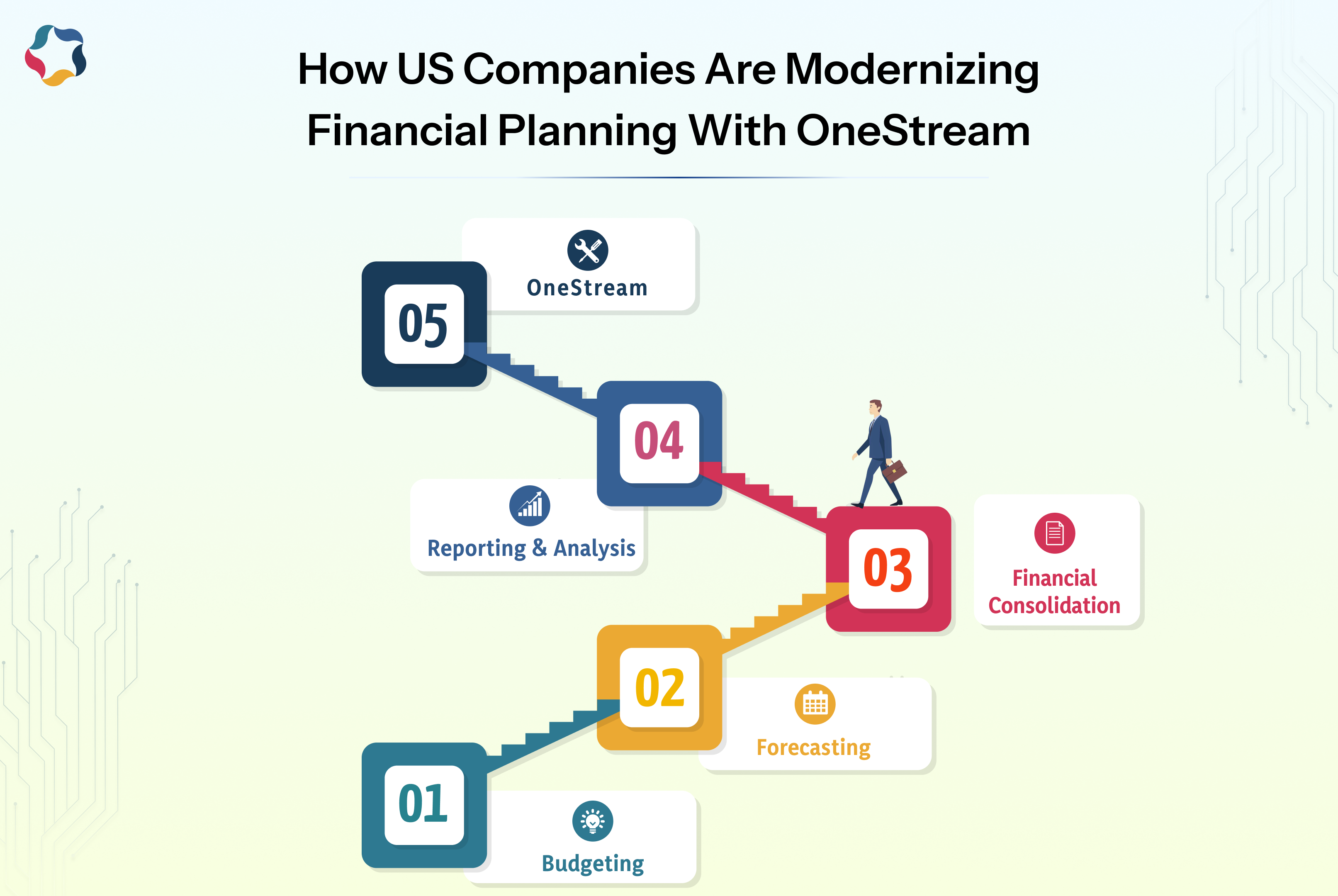
Instead of separate tools for planning, consolidation, and reporting, they are aligning around a unified financial platform.
This is where OneStream is gaining traction—connecting:
- Actuals
- Consolidation
- Planning & forecasting
- Reporting
…within a single, governed model.
What This Shift Looks Like (In Practice)
|
Before
|
After
|
|---|---|
|
Disconnected planning & actuals
|
Direct alignment between both
|
|
Spreadsheet-heavy forecasting
|
Governed, system-driven planning
|
|
Static annual budgets
|
Rolling, continuous forecasts
|
|
Multiple tools & integrations
|
Simplified architecture
|
Real-World Example (What Actually Changes)
A US-based global enterprise (multi-entity, ~$3–5B revenue range) shared this during a finance transformation roundtable:
Before:
- Forecasts took 2–3 weeks to finalize
- FP&A teams maintained parallel Excel models
- Controllers spent significant time reconciling plan vs. actual
- Leadership often reviewed outdated numbers
After moving to a unified planning model:
- Forecast cycles reduced to under 1 week
- Planning and actuals aligned within the same system
- Scenario modeling became same-day, not multi-day
- Leadership started using forecasts in live decision discussions
The biggest shift wasn’t just efficiency — it was decision confidence at speed.
Closing Thought
Finance transformation is no longer about adding better tools.
It’s about ensuring that:
- Planning reflects reality
- Forecasts are trusted
- Decisions happen fast enough to matter
The companies getting this right are not just improving planning — they’re building a connected finance function.


Viren Patel
Managing partner USA
Viren Patel is Managing Partner in USA at Solution Analysts, driving North America growth through OneStream EPM sales, implementation, and account management for CFO and FP&A leaders. Patent-holder, award-recognized leader with 23+ years of experience delivering enterprise performance management, financial consolidation, planning, and analytics solutions.