


Top 10 OneStream Implementation Mistakes Companies Should Avoid
Key Points
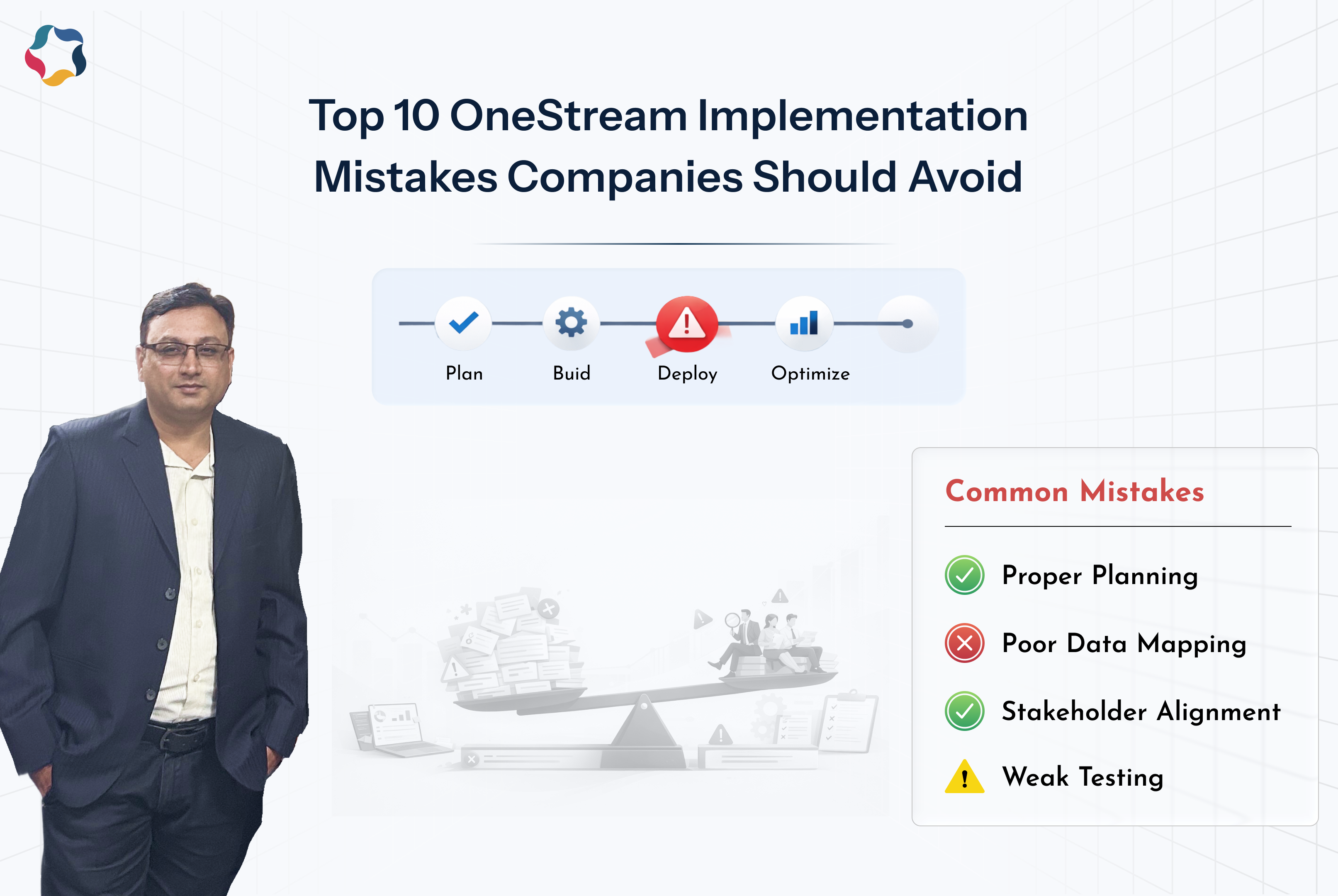
Most OneStream implementation mistakes are not technical failures they are governance failures. The organizations that struggle most underestimate the discipline required to configure, govern, and sustain a unified platform. Every mistake I outline here is one I have witnessed firsthand, and every one is preventable.
Top 10 OneStream Implementation Mistakes
1. Treating OneStream as a Migration Rather Than a Transformation
The most expensive OneStream implementation mistake I encounter is replicating legacy Hyperion or TM1 architectures inside the platform. I have seen enterprises spend six months rebuilding fragmented cube structures, only to re-architect from scratch a year later. OneStream’s value — a unified data model that eliminates reconciliation overhead — disappears entirely when the design mirrors what came before.
Risk: Scope creep accelerates when teams conflate migration with modernization. I insist on a clear architectural north star before a single cube is configured.
2. Deferring Metadata Governance Until After Go-Live
I was called into a consolidation project mid-cycle because inconsistent legal entity hierarchies caused material misstatements in intercompany eliminations. In a separate engagement, ungoverned cost center structures broke a driver-based model mid-budget cycle. Both were preventable — ungoverned metadata is one of the most avoidable OneStream implementation mistakes, yet teams consistently defer it. I treat it as a non-negotiable design constraint enforced from the first sprint.
Risk: Retroactive metadata remediation during a live close cycle is among the highest-risk activities in EPM operations. I refuse to let clients reach that point.
3. Launching Without a Formal Data Integration Architecture
I have never seen a OneStream deployment succeed where integration was an IT afterthought. Undocumented source-to-target mappings produce misaligned actuals and unexplained variances that erode executive trust in the platform. I insist on a formally documented integration architecture — source system ownership, transformation logic, and failure protocols — before build begins.
Risk: A single unexplained variance during a board close cycle can set platform adoption back by an entire quarter. Data trust, once broken, is slow to rebuild.

4. Assigning Configuration Authority to IT Without FP&A Co-Ownership
Technical teams cannot own OneStream in isolation. I have seen cash flow models built without treasury input and consolidation rules configured without the controller’s sign-off — both technically correct and operationally unusable. Finance must co-author the design — this OneStream implementation mistake is structurally damaging when that does not happen.
Risk: Misalignment between configuration and process ownership creates shadow Excel models within weeks of go-live — undermining adoption faster than any technical defect.
5. Underscoping Intercompany Elimination Logic in Consolidation
Elimination logic looks simple on paper and is technically demanding in practice. I always require a consolidation design phase that stress-tests elimination rules against at least two years of historical actuals. I have seen what follows when this is skipped: errors requiring manual correction under regulatory scrutiny during a live audit cycle.
Risk: Multi-entity consolidation errors discovered post-go-live carry audit and regulatory consequences I have seen take quarters to fully resolve. A patch release will not fix them.
6. Building Reports Before the Data Model Is Validated
Report development that outpaces data model maturity is one of the most wasteful OneStream implementation mistakes I encounter. When reporting is built before the data model is validated, every model change cascades into rebuilds. My sequencing rule is non-negotiable: validate the model, confirm integration accuracy, then build reports. Organizations that invert this spend thirty to forty percent more on remediation.
Risk: Report proliferation without a stable data model creates a maintenance burden I have seen consume entire CoE teams long after go-live.
7. Designing Workflows Without Engaging the FP&A Owners
Poorly designed workflow structures are the OneStream implementation mistake that most directly collapses user adoption. When users cannot navigate task sequences, submit inputs in the correct order, or understand lock-and-unlock protocols, I have seen adoption fail within weeks of go-live. I work exclusively with the FP&A leads who own planning cycles — not just those who participate — because that distinction determines whether the design reflects how finance actually operates.
Risk: Workflow redesign post-go-live often requires freezing active planning cycles, directly impacting finance’s ability to support the business.
8. Treating Change Management as Optional
OneStream implementation mistakes are not confined to the configuration layer. I have overseen technically sound deployments that failed because finance teams reverted to spreadsheets within sixty days of go-live. The users I am preparing are not processing transactions — they are making financial decisions. Their confidence must be earned through demonstrated accuracy anchored in their own planning and close cycles — not assumed after a training session.
Risk: Low adoption cannot be recovered through additional configuration. It requires organizational intervention that is expensive, slow, and disruptive.
9. Deferring Security and Access Control to Project Close-Out
Security design is a sequencing problem, and one of the OneStream implementation mistakes I find most frustrating to remediate. I have watched teams defer access control to the final weeks before go-live. In regulated industries, this has produced SOX audit findings requiring emergency correction mid-close. My requirement: security architecture must be designed in parallel with process design and reviewed by internal audit before go-live.
Risk: Retroactive security remediation in a live financial close environment carries operational and compliance consequences that cannot be resolved through a quick fix.
10. Going Live Without a Defined Post-Go-Live Operating Model
The most frequently overlooked OneStream implementation mistake is launching without clarity on who owns the platform after go-live. I consider this the highest structural risk point in any EPM program. I require every client to answer four questions before launch: Who owns release management? How are enhancements prioritized? How are metadata changes governed? How will the platform evolve as the business changes? Without clear answers, organizations manage incidents instead of driving improvement.
Risk: Without a defined operating model, maintenance costs fall disproportionately on external partners indefinitely — both expensive and strategically untenable.
Discipline Determines Outcomes — Not the Technology
I have seen OneStream deliver a genuinely unified view of financial performance across planning, consolidation, forecasting, and close. I have also seen it fail because of avoidable OneStream implementation mistakes made before configuration began. My advice: bring the same rigor to implementation disciplines as to financial reporting standards.

Sameer Pota
Project Manager
Sameer Pota is a Project Manager at Solution Analysts, recognized for effectively managing timelines, resources, and stakeholder communication. As a OneStream expert, he oversees client implementations, ensures seamless project delivery, and mentors developers to maintain best practices and deliver high-quality financial solutions.