


How OneStream Simplifies Financial Consolidation for Modern Finance Teams?
Key Points
Simplicity Over Fragmentation: Why OneStream Financial Consolidation Redefines Control for Modern Finance Teams
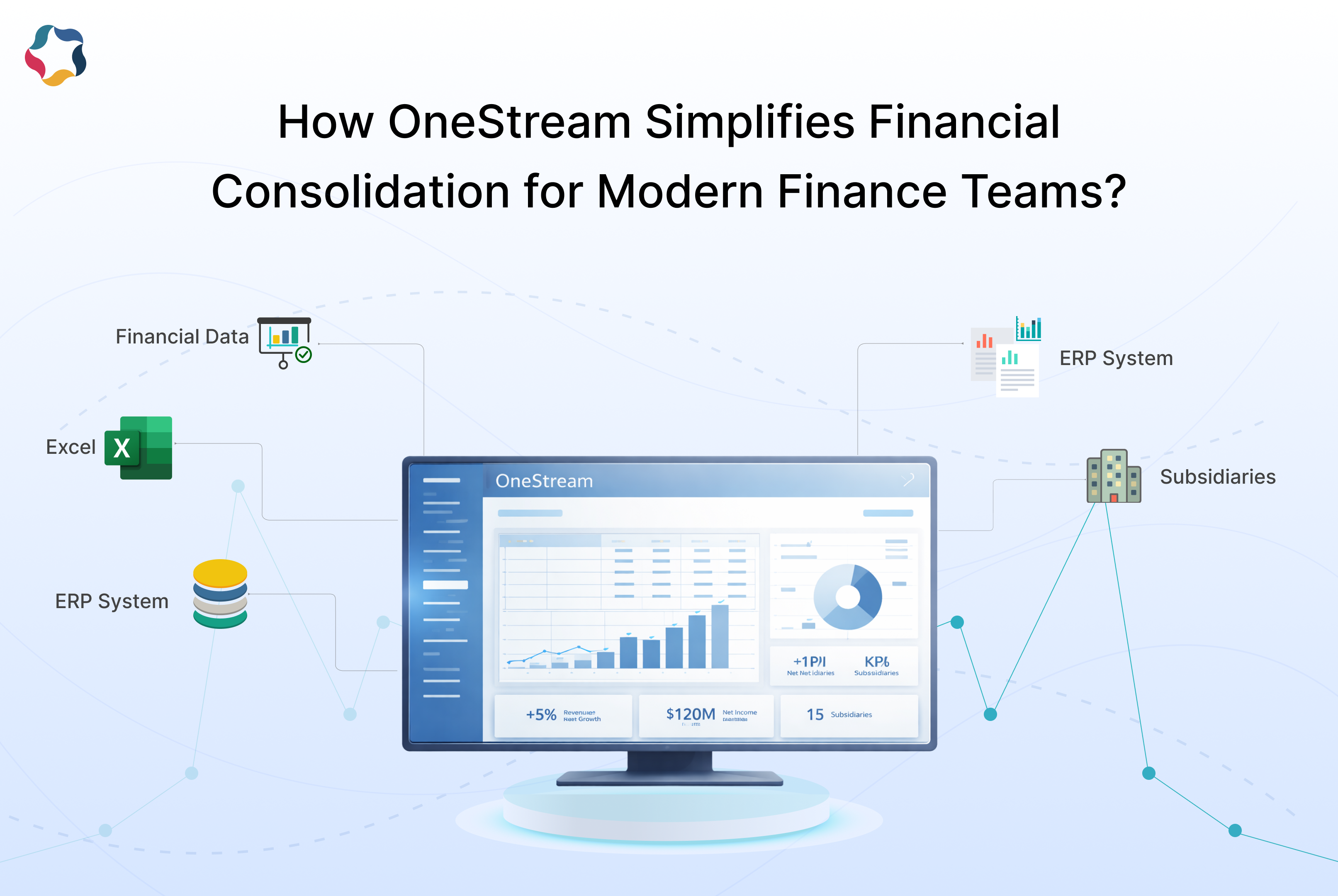
I have seen financial consolidation become simpler with OneStream not because it automates isolated steps, but because it removes fragmentation at the architectural level—bringing data, logic, and workflows into a single controlled environment where finance owns the process end-to-end. That is why OneStream financial consolidation consistently reduces complexity in real enterprise environments: it replaces stitched-together systems with a unified model that eliminates reconciliation gaps, reduces manual intervention, and enforces governance by design.
Unifying the Data Model Eliminates the Root Cause of Complexity
In every large enterprise I have worked with, consolidation complexity does not originate from calculations—it originates from fragmented data models. Multiple systems, inconsistent hierarchies, and disconnected metadata create reconciliation problems that no amount of downstream automation can fix.
With OneStream financial consolidation, I operate within a single extensible dimensional model. Actuals, adjustments, eliminations, and even planning data coexist in the same structure. This is not just a technical convenience—it fundamentally changes how finance operates.
Instead of reconciling between systems, I design once and reuse across the entire consolidation lifecycle. Entity structures, account mappings, and currency logic are governed centrally, eliminating the need for repeated transformations.
The implication for finance leadership is clear: complexity is not reduced by adding tools—it is reduced by removing structural duplication. OneStream financial consolidation achieves that by design.
Integrated Eliminations Remove the Need for Parallel Logic
Intercompany eliminations are where most consolidation processes break down. I have seen organizations maintain separate logic for matching, elimination, and reporting—often across different tools or layers.
In OneStream financial consolidation, eliminations are not an afterthought. They are embedded directly into the consolidation engine, leveraging the same dimensional structure and rules framework. I define elimination logic once, aligned with the data model, and it executes consistently across all entities and scenarios.
What this means in practice is that I no longer depend on reconciliation reports to identify mismatches after the fact. The system enforces alignment during processing.
This shifts the finance function from reactive correction to proactive control. OneStream financial consolidation does not just automate eliminations—it ensures they are structurally consistent and auditable.
Workflow Orchestration Transforms Close from Coordination to Execution
One of the most underestimated sources of inefficiency is workflow fragmentation. Email-driven coordination, offline checklists, and manual sign-offs introduce delays that technology alone cannot solve.
With OneStream financial consolidation, I design workflow as part of the application—not as an external process. Each step of the close cycle, from data load to certification, is orchestrated within a governed workflow framework.
I assign responsibilities, enforce dependencies, and track status in real time. More importantly, I embed validations and controls directly into the workflow, ensuring that data quality is enforced before progression.
The result is not just a faster close—it is a controlled close. Finance leaders gain visibility, accountability, and predictability.
This is where OneStream financial consolidation moves beyond automation and into operational discipline.
Single Platform Architecture Removes Reconciliation Between Planning and Actuals
In most organizations, planning and consolidation operate in separate systems. I have seen the consequences repeatedly: inconsistent assumptions, duplicated data pipelines, and endless reconciliation between forecast and actuals.
OneStream financial consolidation eliminates this divide by enabling planning, forecasting, and consolidation within the same platform and data model. I can design planning processes that directly leverage consolidated data without replication.
This is not just about integration—it is about consistency. When actuals and plans share the same structure, finance teams can analyze variance without questioning data integrity.
From an architectural perspective, this reduces not only system complexity but also cognitive load for users. From a leadership perspective, it enables faster, more confident decision-making.
OneStream financial consolidation simplifies not just processes, but the entire financial narrative.
Embedded Governance Ensures Control Without Additional Overhead
Governance is often treated as a layer added after implementation. In reality, that approach introduces friction and resistance.
In OneStream financial consolidation, governance is embedded within the platform. Security, audit trails, and data lineage are integral to the architecture. Every adjustment, every calculation, and every workflow action is tracked.
I do not need separate tools to enforce control or generate audit evidence. The system inherently supports compliance requirements.
This is particularly critical in multi-GAAP and regulatory environments, where traceability is non-negotiable. I can design consolidation processes that meet audit expectations without introducing additional manual documentation.
The implication is significant: control does not have to slow down finance. With OneStream financial consolidation, control becomes a byproduct of design.
Extensibility Allows Complexity to Be Managed, Not Avoided
Large enterprises do not have simple requirements. Multi-entity structures, multiple currencies, and regulatory variations introduce unavoidable complexity.
What I have learned is that simplification does not mean removing complexity—it means managing it within a controlled framework.
OneStream financial consolidation provides extensibility through business rules and custom logic, allowing me to handle complex scenarios without breaking the core model. Whether it is custom allocation logic, specialized eliminations, or regulatory adjustments, I can implement it within the same governed environment.
This avoids the common trap of pushing complexity into external tools, which only reintroduces fragmentation.
The key takeaway is this: OneStream financial consolidation simplifies operations not by limiting capability, but by containing complexity within a single system.
Performance Optimization Is Achieved Through Design, Not Workarounds
In legacy environments, performance issues are often addressed with workarounds—pre-aggregations, data extracts, or offline processing.
In OneStream financial consolidation, performance is a function of model design and processing strategy. I have optimized consolidation cycles from hours to minutes by restructuring data flows, leveraging connector-based loading, and aligning workflows with processing logic.
Because everything operates within a unified platform, I can control performance holistically rather than tuning isolated components.
This reinforces a critical principle: simplification is not just about usability—it is about operational efficiency. OneStream financial consolidation enables both.
The Trade-Off: Simplification Requires Strong Governance and Design Discipline
It would be incomplete to suggest that OneStream financial consolidation is effortless. The simplification it delivers is the result of disciplined design and governance.
I have seen implementations struggle when organizations attempt to replicate legacy structures without rethinking their architecture. The flexibility of the platform can become a liability if not governed properly.
There is also a change management component. Moving from fragmented systems to a unified platform requires alignment across finance, IT, and business stakeholders.
However, in my experience, this trade-off is necessary. The effort invested in proper design and governance is what enables long-term simplification.
OneStream financial consolidation does not eliminate responsibility—it centralizes it.
Simplification Is Not a Feature—It Is an Architectural Outcome
What distinguishes OneStream financial consolidation is that simplification is not delivered through isolated features. It is the result of an architectural philosophy that prioritizes unification, governance, and extensibility.
Every time I implement OneStream financial consolidation, I am not just deploying a tool—I am redefining how finance operates. I am removing redundancies, enforcing consistency, and enabling control.
This is why the impact is not incremental—it is structural.
Conclusion: Finance Leaders Must Choose Between Managing Complexity and Eliminating It
In my experience, finance teams do not struggle because consolidation is inherently complex—they struggle because their systems are fragmented.
OneStream financial consolidation simplifies financial consolidation by addressing this root cause. It unifies data, embeds governance, and orchestrates workflows within a single platform, enabling finance to operate with control and confidence.
The decision for finance leadership is not whether to modernize—it is whether to continue managing complexity or to eliminate it at the source.
If the goal is a faster close, consistent data, and audit-ready processes, then the path is clear: adopt an architecture that enforces simplicity by design.
That is exactly what OneStream financial consolidation delivers.

Rajan Shah
Technical Manager
Rajan Shah is a Technical Manager with OneStream Expertise at Solution Analysts. He brings almost a decade of experience and a genuine passion for software development to his role. He’s a skilled problem solver with a keen eye for detail, his expertise spans in a diverse range of technologies including Ionic, Angular, Node.js, Flutter, and React Native, PHP, and iOS.