


OneStream vs Traditional Financial Consolidation Tools: What Modern Finance Teams Need
Key Points
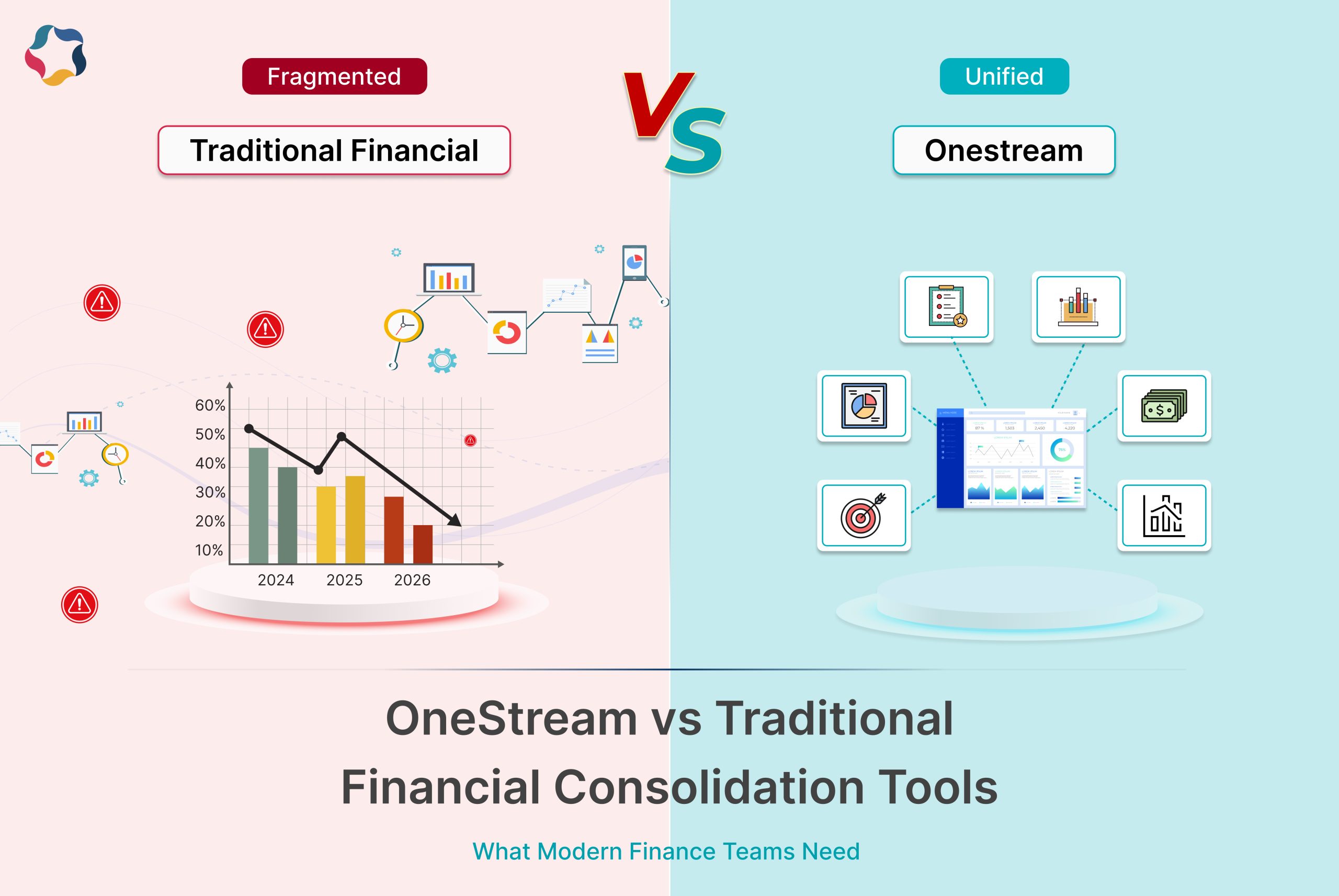
I have seen traditional financial consolidation tools fail not because they lack capability, but because they fundamentally cannot sustain a controlled, unified finance operating model; they fragment data, logic, and accountability. In contrast, OneStream financial consolidation changes the outcome by enforcing a single, governed architecture where consolidation, planning, and reporting coexist without reconciliation layers, and that difference is what modern finance teams actually need.
Traditional Tools Fragment the Finance Model; OneStream Forces Architectural Unity
In every Hyperion or SAP BPC replacement I have led, the core issue was never consolidation logic—it was fragmentation. Consolidation sat in one system, planning in another, reporting often in Excel, and data validation somewhere in between.
This fragmentation creates invisible risk:
- Different data models across systems
- Duplicate logic for currency, eliminations, and adjustments
- Reconciliation layers that become permanent instead of transitional
When I implement OneStream financial consolidation, I am not just replacing a consolidation engine—I am collapsing the architecture into a single governed model. The same dimensionality drives consolidation, planning, and reporting. There is no duplication of logic, and more importantly, no ambiguity about which number is correct.
For CFOs, this means one version of truth is no longer aspirational—it becomes enforceable.
Legacy Consolidation Depends on Reconciliation; OneStream Eliminates the Need for It
In traditional environments, reconciliation is treated as a control mechanism. In reality, it is a symptom of architectural failure.
I have seen teams spend days reconciling:
- Consolidation outputs vs planning numbers
- Actuals vs reporting extracts
- Intercompany balances across disconnected systems
These reconciliations exist because systems do not share the same logic or data foundation.
With OneStream financial consolidation, reconciliation becomes structurally unnecessary. The same engine processes actuals, eliminations, adjustments, and planning data. When I design the solution correctly, intercompany eliminations, FX translations, and reporting hierarchies all operate on the same dataset.
The implication is direct: finance teams shift from validating numbers to analyzing them.
Close Cycle Delays Are Structural in Legacy Systems; OneStream Compresses the Timeline by Design
Traditional tools extend the close cycle not because of processing time, but because of dependency chains:
- Data load delays due to multiple staging layers
- Manual adjustments outside the system
- Reporting dependencies on post-consolidation extracts
I have worked with finance teams where “close” is technically complete, but reporting is still catching up days later.
When I implement OneStream financial consolidation, I design the close as an integrated process:
- Data ingestion, validation, and consolidation are unified
- Adjustments are controlled and auditable within the platform
- Reporting is immediately available on the same data model
This eliminates the artificial lag between consolidation and insight.
For Controllers, this changes accountability: close is not complete until reporting is ready—and OneStream makes that achievable.
Intercompany Complexity Breaks Legacy Models; OneStream Handles It as a Core Design Principle
Intercompany reconciliation is where most traditional systems start to show strain.
In fragmented architectures, intercompany logic is often:
- Partially in the consolidation tool
- Partially in upstream systems
- Partially managed through manual adjustments
This creates mismatches that finance teams spend cycles resolving every month.
With OneStream financial consolidation, I treat intercompany as a first-class construct:
- Matching rules, eliminations, and reporting are unified
- Discrepancies are visible in real time
- Adjustments are controlled within the same system
More importantly, the system enforces discipline. If data is misaligned, it is exposed immediately—not discovered during late-stage reconciliation.
For finance leadership, this reduces both operational effort and audit risk.
Planning and Consolidation Separation Is a Structural Weakness; OneStream Unifies Them
One of the most persistent limitations I see is the separation between planning and consolidation.
In legacy environments:
- Planning models are simplified versions of actuals
- Data must be mapped between systems
- Forecasts rarely align cleanly with reported numbers
This disconnect leads to a fundamental credibility issue—finance cannot confidently explain variances because the systems are not aligned.
When I deploy OneStream financial consolidation, planning and consolidation operate on the same dimensional structure. This has several consequences:
- Forecasts reconcile naturally with actuals
- Scenario modeling uses the same business logic
- Variance analysis becomes meaningful instead of reconciliatory
This is not a feature advantage—it is an architectural correction.
For FP&A leaders, this enables forward-looking analysis without compromising data integrity.
Data Governance Is Reactive in Legacy Systems; OneStream Embeds It in the Platform
Traditional tools rely heavily on process-driven governance:
- Manual controls
- Offline validations Post-process audit reviews
These controls are necessary because the system itself does not enforce governance.
In contrast, OneStream financial consolidation embeds governance directly into the platform:
- Data validation rules are enforced at load and transformation stages
- Audit trails capture every adjustment and transformation
- Security and workflow controls are integrated into the process
When I design governance in OneStream, I am not adding controls—I am leveraging the system’s inherent structure.
This shifts governance from reactive to preventive.
For audit and compliance teams, this reduces dependency on manual evidence collection and increases confidence in system-driven controls.
Excel Dependency Is a Sign of System Failure; OneStream Reduces It Without Eliminating Flexibility
I do not view Excel as a problem. I view uncontrolled Excel dependency as a symptom.
In traditional setups, Excel becomes:
- A parallel reporting system
- A workaround for system limitations
- A hidden layer of business logic
This creates risks that are difficult to quantify and harder to audit.
With OneStream financial consolidation, I reduce the need for Excel by ensuring the system can handle:
- Complex reporting requirements
- Ad hoc analysis
- Data adjustments within controlled workflows
However, I do not eliminate Excel entirely. Instead, I reposition it as a consumer of governed data rather than a source of truth.
For finance teams, this preserves flexibility while restoring control.
The Real Trade-Off: OneStream Demands Discipline That Legacy Systems Allow You to Avoid
It would be incomplete to present OneStream as a universally easier path. It is not.
The most significant trade-off I have observed is the level of discipline required:
- Data models must be designed correctly upfront
- Governance cannot be deferred
- Business processes must align with system capabilities
Traditional tools allow teams to compensate for poor design with manual workarounds. OneStream financial consolidation does not tolerate that approach.
Implementation effort is higher—not because the tool is complex, but because it enforces architectural correctness.
In my experience, organizations that underestimate this requirement struggle during implementation. Those that embrace it achieve a fundamentally different operating model.
For CFOs, this is a strategic decision: invest in discipline now or continue funding inefficiency indefinitely.
Conclusion: Modern Finance Requires Architectural Integrity, Not Incremental Improvement
I do not see this as a tool selection decision. I see it as a choice between maintaining a fragmented finance architecture or committing to a unified, governed model.
Traditional consolidation tools can be extended, optimized, and supported—but they cannot eliminate the structural issues that create reconciliation effort, delay insights, and weaken control.
OneStream financial consolidation addresses those issues at the architectural level. It replaces fragmentation with unity, reconciliation with consistency, and manual control with embedded governance.
For CFOs and Controllers, the implication is clear: if the objective is faster close, reliable numbers, and scalable finance operations, incremental improvement is insufficient.
A unified platform like OneStream is not just a better tool—it is the only approach I have seen that fundamentally changes how finance operates.


Rajan Shah
Technical Manager
Rajan Shah is a Technical Manager with OneStream Expertise at Solution Analysts. He brings almost a decade of experience and a genuine passion for software development to his role. He’s a skilled problem solver with a keen eye for detail, his expertise spans in a diverse range of technologies including Ionic, Angular, Node.js, Flutter, and React Native, PHP, and iOS.