


OneStream Extensible Dimensionality: The Feature That Changes Everything
Key Points
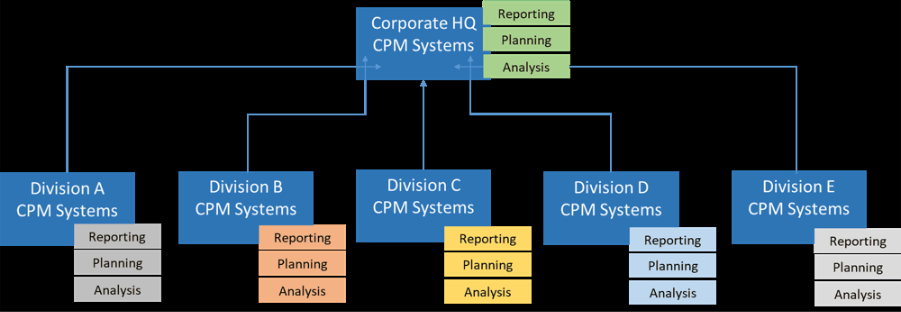
Figure 1: Fragmented CPM systems often rely on disparate tools and spreadsheets.
Extensible dimensionality truly changes everything because it allows organizations to maintain a single, standardized financial model while still capturing unlimited business-level detail without complexity. This is exactly what OneStream extensible dimensionality delivers. It enables companies to extend core dimensions such as Accounts, Entities, Products, or Customers at the business-unit level—without breaking corporate governance or reporting consistency. In simple terms, organizations no longer must choose between standardization and flexibility. With OneStream extensible dimensionality, they get both. Corporate finance retains full control, while business users gain the freedom to model their operations in the detail they need. This architectural innovation eliminates data silos, reduces manual work, and creates a true single source of truth across the enterprise.
Why Extensibility Matters
For finance teams, IT professionals, and CFOs, the ability to extend a common model is transformational. OneStream extensible dimensionality refers to the platform’s built-in capability to let business units inherit a standard dimension and then add their own members. In practice, each division can break down a corporate account or entity into finer line items without altering the shared corporate chart of accounts. This is not a workaround or a one-off fix – it’s a fundamental part of the platform’s original design. The result is that each unit gets the exact detail it needs for planning or reporting, while corporate retains control and consistent roll-ups. OneStream’s documentation emphasizes that business units can inherit a standard set of dimensions from corporate and extend them to suit their own reporting requirements. In effect, teams gain operational flexibility without sacrificing corporate governance.
Extensible dimensionality even extends beyond accounts: for example, different legal entities or locations can have their own sub-hierarchies, and product or flow dimensions (like revenue flows or custom drivers) can be extended by divisions as needed. For instance, one subsidiary could define additional product categories in its own planning cube while the global organization sees only the aggregated categories. In short, extensible dimensionality allows the model to grow organically with the business’s needs. As a result, enhancements often involve simply adding new members under existing parents rather than costly redesigns. This agility is a significant advantage when business needs evolve.
In fact, OneStream supports separate dimension hierarchies for different processes through “virtual” cubes. You can assign extended dimensions differently by cube or scenario type: for example, a corporate consolidation cube might use the standard accounts, while a Services budgeting cube uses an extended account list. Similarly, workflows and business rules can be configured per process. These capabilities make OneStream truly adaptable to complex, enterprise needs.
Extensible Dimensionality in Action
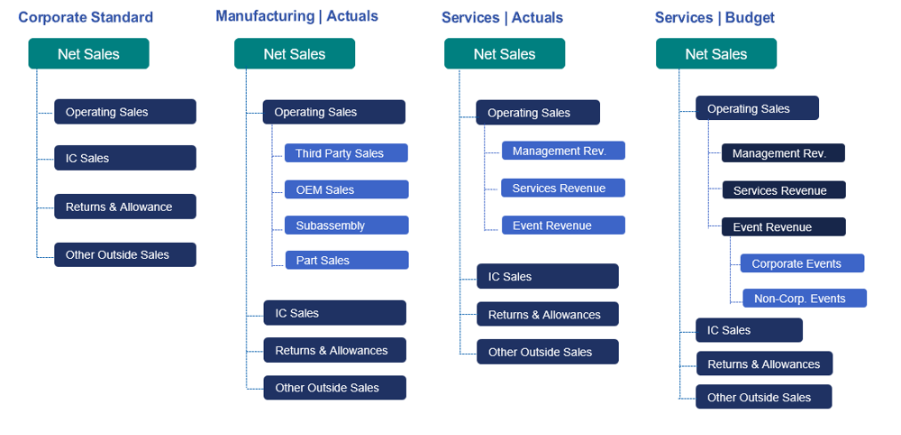
Figure 2: OneStream extensible dimensionality adapts a single corporate account to different business needs.
Consider a corporate Operating Sales account as shown in Figure 2. OneStream allows you to define this account once at the corporate level. Then individual business units extend it differently: the manufacturing division adds subaccounts for Third-Party Sales, OEM Sales, Subassembly, and Parts Sales, while the services division adds Management Revenue, Services Revenue, and Event Revenue. Furthermore, the services team can break down Event Revenue even further (for example, splitting it into corporate versus non-corporate events) in its budget. Because the Operating Sales account exists only once, any report or consolidation rule referencing that account automatically includes all these extended children. In other words, reports, rules and security related to the Operating Sales account do not need to be re-created or modified. The corporate chart of accounts and dimensions remain shared, so the additional members added by each division simply roll up under the same standardized accounts. This eliminates the need for offline spreadsheets, one-off scripts, or multiple CPM instances. In each case, the core “Operating Sales” account was unchanged – the detailed sales variants simply accumulated under one standard total.
Key Benefits of OneStream Extensible Dimensionality
- Unified Platform: OneStream extensible dimensionality ensures all business units share a common model and chart of accounts, yielding enterprise-wide standardization. Finance teams have a single version of the truth and do not need to reconcile multiple structures.
- Rapid Drill-Through: Corporate users can instantly drill from consolidated results into the detailed drivers beneath them, providing deeper insights and faster decision-making. Forecasts or actuals by product, location, or customer are automatically aligned with the top-line figures.
- Lower Maintenance: There is only one set of metadata, rules, and security to maintain. IT and finance teams avoid the manual reconciliation workflows and fragile integrations that come with siloed systems. Changes to dimensions or hierarchies apply everywhere at once.
- Cost Reduction: By eliminating spreadsheets, point solutions, and multiple application instances, organizations dramatically reduce complexity and total cost of ownership. The need for custom code or offline consolidation processes is removed.
- Agility and Speed: New planning or reporting processes can be implemented faster because existing dimensions and rules are reused. OneStream customers report faster deployments of new solutions and lower-cost upgrades thanks to the platform’s unified architecture.
For CFOs and finance leaders, OneStream extensible dimensionality means predictable consolidations and faster close cycles. Corporate accountants can close the books globally while divisional managers simultaneously perform detailed product-level planning – all in one application. Meanwhile, IT teams appreciate that the integration and upgrade burden is drastically reduced. In fact, organizations are consolidating their software landscapes: customers report eliminating dozens of legacy CPM applications (for example, many replaced multiple Hyperion modules, Essbase cubes, and standalone planning spreadsheets) in favor of a single OneStream solution. This simplifies the IT footprint and reduces technical debt, while finance teams benefit from having all the detail accessible. OneStream extensible dimensionality makes it easy to navigate from a corporate budget line directly into the underlying detail without having to switch systems – providing rapid answers to critical business questions.
From the consultant perspective, the benefit is equally clear. The platform’s flexibility spans beyond dimensions: OneStream supports extensibility in cubes, workflows, and data integrations as well. Project phases naturally build on each other: the metadata, rules and reports established for consolidations are immediately available for budgeting, forecasting or advanced analytics. For example, a product hierarchy defined for the global close is already in place for profit planning or driver-based budgeting. This reuse means less work for consultants on each new phase. In short, OneStream extensibility makes implementations faster and less risky: project teams spend less time on low-level configuration and more on value-added analysis. It also ensures that future changes – such as adding a new business unit or dimension – can be handled by extending existing models rather than re-engineering from scratch.
In summary
OneStream extensible dimensionality gives organizations both corporate control and business flexibility. Everything ultimately rolls up to the shared dimensions, so there truly is one version of the truth and a single source for reporting and analysis. Finance teams get broad oversight and granular detail in the same system, while technical teams manage only one unified platform. This combination of control and flexibility – unique to OneStream’s architecture – is what makes this platform stand out. Many experts even say that OneStreams extensible dimensionality is truly the feature that changes everything in modern CPM.
Sources:
OneStream documentation and Whitepapers
OneStream extensible dimensions
Extensibility series an overview of extensibility
The Power of an Extensible CPM
Harnessing the power of OneStream extensible dimensionality
What is extensible dimensionality


Darshakkumar Prajapati
Lead Engineer
Darshak is a Lead Software Development Engineer with strong expertise in OneStream, including Cube Views, Dashboards, Business Rules, and advanced reporting solutions. He has 7+ years of experience delivering scalable enterprise applications across diverse domains.Specializing in Node.js, JavaScript, Angular, and DevOps, Darshak brings robust debugging and problem-solving skills to every project. Passionate about knowledge sharing, he actively contributes insights and best practices to the broader developer community.