


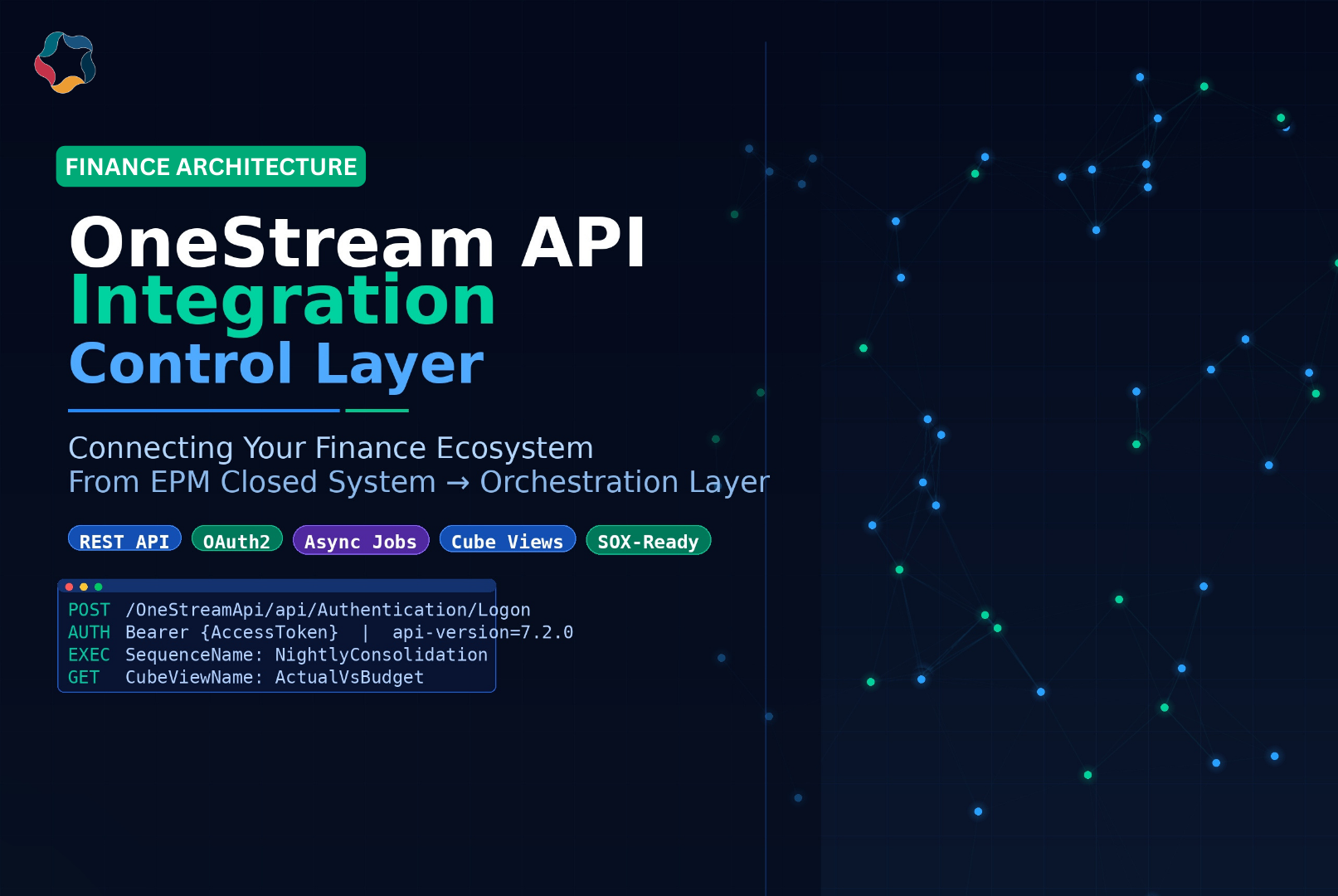
OneStream API: Connecting Your Finance Ecosystem
Key Points
OneStream API Integration Is No Longer Optional — It’s the Control Point of Your Finance Architecture
If you treat OneStream API integration as a reporting convenience, you will underuse it; if you treat it as the control plane of your finance ecosystem, you will redesign how planning, consolidation, and automation actually work.
I don’t see the OneStream REST API as an add-on. I see it as the structural mechanism that determines whether finance remains a system of record — or becomes a system of orchestration.
OneStream API Integration Turns EPM From a Closed System into an Operating Layer
The OneStream REST API exposes services through a structured URL pattern:
https://{Server}/OneStreamApi/api/{Service}/{Action}?api-version={version}
It operates over HTTPS, uses JSON, and requires OAuth2 authentication.
This is not just data retrieval — this is controlled execution of finance processes.
Through structured OneStream API integration, We can:
- Authenticate using OAuth2 / Personal Access Tokens
- Logon and obtain Session Info (SI)
- Open application context
- Execute Cube View extractions
- Trigger consolidations and sequences
This makes OneStream executable from outside its UI.
Authentication Is the First Architectural Decision
The authentication flow is structured and deliberate:
- Obtain OAuth token from Azure AD / Okta / PingFederate
- Call Logon endpoint
- Receive Session Info (SI)
- Open Application
Example – Logon Call
Endpoint
POST /OneStreamApi/api/Authentication/Logon?api-version=7.2.
Headers
Authorization: Bearer {AccessToken}
Content-Type: application/json
Accept: application/jso
Body
{ “BaseWebServerUrl”: “https://instance.onestreamcloud.com/OneStreamWeb“
The response returns Session Info (SI), which must be included in nearly all subsequent calls.
Architectural point:
SI must be cached in memory only and never stored in logs or databases. Token lifecycle management becomes part of your control design.
This is where weak OneStream API integration implementations fail — not in code, but in governance.
Planning Automation Requires Executable Sequences, Not Manual Clicks
The Data Management APIs allow execution of sequences and steps.
If ERP actuals load nightly, I should not rely on someone manually running consolidation.
Example – Execute Consolidation Sequence
Endpoint
POST /OneStreamApi/api/DataManagement/ExecuteSequence?api-version=7.2.
Headers
Authorization: Bearer {AccessToken}
Content-Type: application/jso
Body
{ “SequenceName”: “NightlyConsolidation”, “SI”: { “XfBytes”: “EncodedSessionToken”}}
This triggers:
- Consolidation
- Currency translation
- Workflow steps
- Cube recalculation
When I deploy serious OneStream API integration, I embed this inside:
- Enterprise schedulers
- SAP batch jobs
- Cloud orchestration tools
- DevOps pipelines
That turns planning and forecasting into event-driven processes.
Governed Reporting Must Use Cube Views, Not Raw SQL
The Data Provider service allows retrieving Cube View data.
This is the correct integration pattern for BI tools.
Example – Cube View Extraction (cURL)
curl -X POST “https://server/OneStreamApi/api/DataProvider/GetAdoDataSetForCubeViewCommand?api-version=7.2.0” \
-H “Authorization: Bearer TOKEN” \
-H “Content-Type: application/json” \
-d ‘{
“CubeViewName”:”ActualVsBudget”,
“SI”:{“XfBytes”:”TOKEN”}
}’
Why this matters:
- Cube Views enforce dimensional logic.
- Security roles are respected.
- Calculations remain consistent.
- BI outputs reconcile with financial statements.
Yes, SQL endpoints exist.
But they should not be your default strategy.
When We design OneStream API integration, Cube Views are my contract layer between finance and analytics.
Asynchronous Jobs Are Non-Negotiable for Enterprise Close
Long-running operations must use async patterns with polling.
Typical Async Pattern
- Submit request
- Receive Job ID
- Poll status endpoint
- Retrieve results
If you attempt synchronous execution for large consolidations, you will face timeouts.
Performance Depends on Discipline
The documentation explicitly recommends:
- Prefer Cube Views over SQL
- Apply filters and POV restrictions
- Use async endpoints
- Cache Session Info for batch operations
This is not optimization advice — it’s survivability guidance.
If you extract entire cubes without filtering, you will overload both OneStream and downstream systems.
Enterprise integration requires:
- Dimension filtering
- Scenario scoping
- Paging for large datasets
- Token refresh management
OneStream API integration is powerful, but it is not forgiving of careless design.
Integration With Identity Providers Is a Control Issue, not a Setup Step
The API supports Azure AD (Microsoft Entra ID), Okta, and PingFederate configurations.
From a control perspective, this means:
- Access can be centrally managed.
- Secrets must be rotated.
- Least-privilege principles must apply.
- OAuth scopes must align with internal controls.
For SOX-sensitive environments, API access becomes part of your ITGC design.
Weak identity architecture undermines even the best technical OneStream API integration.
Conclusion: OneStream API Integration Is the Finance Orchestration Layer
If you use OneStream API integration to export reports, you will gain incremental efficiency.
If you use it to orchestrate:
- Consolidation
- Forecast refresh
- Close workflow
- BI synchronization
- ERP-triggered automation
You redefine finance operations.
The REST API provides:
- Secure OAuth authentication
- Session-based execution context
- DataProvider services for governed extraction
- Data Management endpoints for automation
- Async job orchestration
That is enough to make finance programmable.
My position remains firm:
OneStream API integration is not a technical feature — it is the control layer that determines whether your EPM architecture is reactive or orchestrated.
The question for finance leaders is not whether to integrate.
It is whether you will architect it deliberately — or allow it to evolve accidentally.
Reference:


Darshakkumar Prajapati
Lead Engineer
Darshak is a Lead Software Development Engineer with strong expertise in OneStream, including Cube Views, Dashboards, Business Rules, and advanced reporting solutions. He has 7+ years of experience delivering scalable enterprise applications across diverse domains.Specializing in Node.js, JavaScript, Angular, and DevOps, Darshak brings robust debugging and problem-solving skills to every project. Passionate about knowledge sharing, he actively contributes insights and best practices to the broader developer community.