


Intercompany Matching Is Broken by Design – Why Legacy Platforms Keep Failing at intercompany reconciliation software
Key Points
Introduction
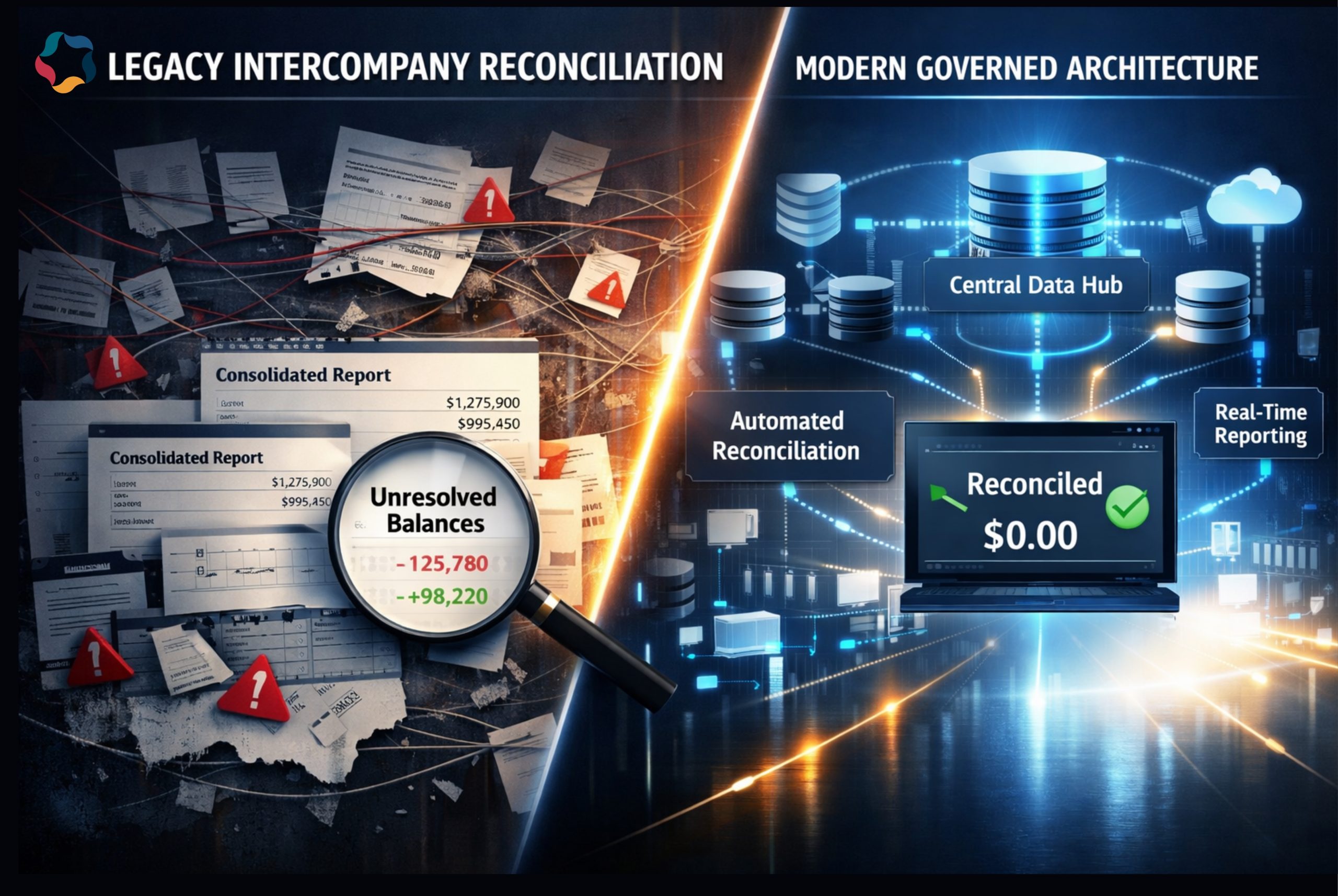
Legacy CPM platforms fail at intercompany matching because they were never designed to treat intercompany as a first-class operational process; they treat it as a post-consolidation accounting clean-up, and no amount of configuration, governance overlays, or manual effort can turn that architectural flaw into reliable intercompany reconciliation software.
Legacy platforms fail because they treat intercompany as an exception, not a system
In every legacy CPM implementation I have worked on, intercompany is implicitly assumed to be “mostly right.” Matching exists, eliminations exist, reports exist—but none of them assume that intercompany is structurally fragile. The system expects alignment and merely highlights deviations.
That assumption is fundamentally wrong.
Intercompany is not fragile because teams are careless; it is fragile because the operating reality of multi-entity organizations guarantees timing differences, pricing disputes, partial settlements, and classification mismatches. Legacy intercompany reconciliation software is built to surface these issues, not to absorb and govern them.
What this means in practice is predictable: breaks are discovered late, reconciled manually, and explained outside the system. The tool never becomes the system of record for intercompany truth it becomes a reporting layer on top of unresolved operational reality. Once that pattern sets in, matching quality degrades month after month.
Matching fails when reconciliation is disconnected from the close
I have never seen reliable intercompany matching in an environment where reconciliation is logically separated from the close workflow. Legacy tools often allow matching to run independently, on a separate timeline, with no enforceable dependency on consolidation readiness.
This creates a dangerous illusion of progress.
Teams run consolidation while intercompany mismatches still exist, assuming they will be “fixed later.” Eliminations are posted with suspense logic. Journals are added to make numbers agree. The close technically completes, but intercompany integrity deteriorates.
True intercompany reconciliation software must make matching a gate, not a side process. When reconciliation is embedded directly into close orchestration when entities cannot certify until counterpart mismatches are resolved behavior changes immediately. That is not a feature advantage; it is an operating-model decision.
Legacy platforms cannot enforce that discipline because their architecture allows reconciliation to remain optional.
Excel survives because legacy intercompany models cannot handle judgment
Every CFO I speak to wants Excel removed from intercompany, yet almost all legacy environments still depend on it. This is not hypocrisy; it is rational behavior.
Legacy intercompany reconciliation software struggles with real-world judgment: partial accruals, provisional pricing, FX timing differences, dispute staging, and temporary misalignment between trading partners. The system expects symmetry, while reality delivers asymmetry.
Excel fills that gap because it allows humans to model imperfection without breaking the system.
In implementations where intercompany logic is designed natively – where mismatches can be categorized, aged, annotated, and resolved without external workbooks – Excel use collapses naturally. Not because it is forbidden, but because the system finally respects operational nuance.
When intercompany reconciliation software cannot model judgment, people will always export judgment elsewhere.
Eliminations fail when matching is treated as an accounting problem
Legacy CPM platforms tend to frame intercompany as an elimination problem: if the numbers net to zero at consolidation, the system has “worked.” That framing is deeply misleading.
Eliminations hide problems; they do not resolve them.
I have seen environments where eliminations balance perfectly every month, yet intercompany aging worsens, disputes accumulate, and trust between entities erodes. Controllers celebrate a clean consolidation while operational finance teams quietly maintain parallel reconciliation logs.
Effective intercompany reconciliation software reverses the logic. Eliminations become a result of resolved matching, not a substitute for it. When eliminations are allowed to compensate for unresolved mismatches, the system actively undermines governance.
Legacy platforms fail here because their data models do not force causality between matching and elimination. OneStream-based designs do not through marketing promises, but through structural enforcement.
Close speed suffers because intercompany issues surface too late
One of the most underestimated impacts of weak intercompany reconciliation software is close volatility. Late intercompany breaks trigger reruns, emergency journals, and executive escalations precisely when time pressure is highest.
In legacy environments, this is accepted as normal.
In architectures where intercompany matching is embedded early in the close cycle, the opposite happens: breaks surface sooner, when corrective action is cheaper. Upstream entities adjust booking behavior. FP&A gains confidence in early actuals. Controllers stop firefighting at the eleventh hour.
Close acceleration is not achieved by working faster at the end; it is achieved by discovering intercompany truth earlier. Legacy tools structurally prevent that by relegating reconciliation to a downstream activity.
Governance collapses when accountability is not enforced by the system
Legacy intercompany reconciliation software relies heavily on policy documents and RACI charts to define accountability. The system itself remains permissive.
As a result, ownership becomes negotiable. Disputes linger because no entity is forced to resolve them before certifying. Aging reports exist, but they do not block progress. Governance becomes performative rather than operational.
In environments where reconciliation ownership is enforced technically where unresolved mismatches prevent certification—governance becomes real. The system does not ask who is responsible; it already knows.
This is the difference between documenting governance and operationalizing it. Legacy platforms rarely cross that line.
Planning and forecasting are quietly polluted by unresolved intercompany
Most organizations underestimate how badly weak intercompany reconciliation software distorts planning and forecasting. When intercompany mismatches persist, forecast baselines become unreliable. FP&A teams compensate by applying overlays and adjustments that are never fully reconciled back to actuals.
Over time, the gap between forecast logic and actual booking behavior widens.
In architectures where intercompany matching is resolved systematically and historically traceable, forecast accuracy improves—not because planners work harder, but because actuals are structurally cleaner. Planning stops compensating for unresolved operational debt.
Legacy tools struggle here because they treat reconciliation as a reporting concern, not a data-quality foundation.
Auditability fails when explanations live outside the system
I have supported too many audits where intercompany explanations live in emails, spreadsheets, and meeting notes rather than in the CPM platform itself. Legacy intercompany reconciliation software can show numbers, but it cannot tell stories.
Auditors do not only care that balances agree; they care why they agree. When explanations are external, audit confidence degrades, and finance teams burn time reconstructing rationale months after the fact.
When intercompany reconciliation software allows explanations, dispute status, and resolution history to live alongside balances, audit conversations change. Questions become confirmatory rather than investigative.
Legacy platforms rarely enable this natively. The result is institutional memory loss every close cycle.
The trade-off: strong intercompany design reduces flexibility
There is a real trade-off in adopting stricter intercompany reconciliation software. When reconciliation is enforced structurally, flexibility decreases. Entities cannot “push issues to next month.” Temporary workarounds are harder to justify.
Some organizations resist this because it exposes weak upstream processes or unresolved commercial disagreements. In early phases, close effort may actually increase as discipline is imposed.
This is not a flaw; it is a cost of maturity.
Intercompany integrity cannot coexist with unlimited flexibility. Organizations must decide whether speed and trust are worth that constraint. Legacy tools avoid this decision by allowing ambiguity to persist.
Why legacy tools keep failing even after upgrades
Many enterprises upgrade legacy CPM platforms expecting intercompany improvements, only to see the same problems persist. The reason is simple: the underlying intercompany reconciliation software model has not changed.
New interfaces, faster engines, and better reports do not alter the fact that reconciliation remains optional, explanations remain external, and governance remains manual.
Without re-architecting intercompany as an enforced operational process, no upgrade will fix the problem. OneStream succeeds where legacy tools fail not because it is newer, but because it allows—and encourages—a fundamentally different intercompany design philosophy.
Conclusion: intercompany failure is an architectural choice
Intercompany matching does not fail because teams lack discipline; it fails because systems allow indiscipline to survive. Legacy intercompany reconciliation software was never built to absorb operational complexity, enforce accountability, or serve as a single source of intercompany truth.
For CFOs, this means continued close volatility and audit friction. For Group Controllers, it means perpetual reconciliation fatigue. For EPM decision-makers, it means recognizing that intercompany success is not a configuration exercise—it is an architectural commitment.
Until intercompany is treated as a governed process rather than an accounting afterthought, legacy platforms will keep failing in exactly the same way.

Rajan Shah
Technical Manager
Rajan Shah is a Technical Manager with OneStream Expertise at Solution Analysts. He brings almost a decade of experience and a genuine passion for software development to his role. He’s a skilled problem solver with a keen eye for detail, his expertise spans in a diverse range of technologies including Ionic, Angular, Node.js, Flutter, and React Native, PHP, and iOS.