


The Hidden Cost of Bad Financial Reporting – A Reality for US Companies
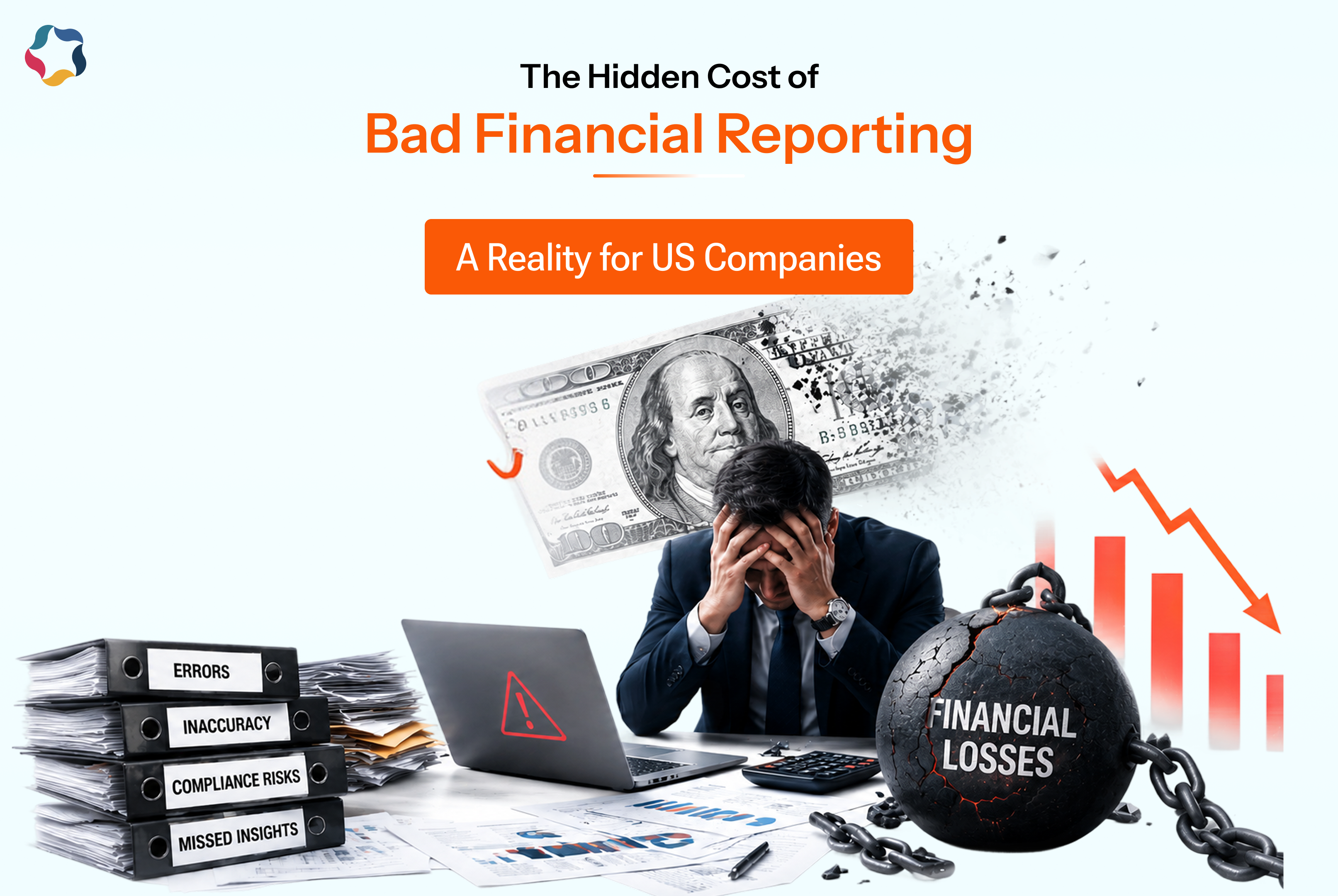
(Why finance delays quietly become business risks)
The meeting already happened.
The decision was already made.
Then finance realized the numbers were incomplete.
Not technically wrong.
Not materially misstated.
Not materially misstated.
Just:
- delayed
- fragmented
- disconnected from operational reality
And across many organizations in financial reporting USA, that’s becoming a bigger risk than finance teams want to admit.
The Real Problem Isn’t Accuracy
Most finance leaders worry about:
- audit findings
- reporting compliance
- reporting errors
But the hidden cost of poor financial reporting is usually something else:
– leadership slowly losing confidence in finance’s ability to respond fast enough.
Because the real cost of reporting delays isn’t slower reporting.
– It’s slower decisions during moments that matter.
A Situation Most Finance Leaders Recognize Immediately
You’re in a leadership meeting.
Revenue looks stable.
Margins appear under control.
Margins appear under control.
Then someone asks:
“What happens if demand drops next quarter?”
The room pauses.
FP&A reruns scenarios.
Controllers validate assumptions.
IT checks which numbers are current.
Controllers validate assumptions.
IT checks which numbers are current.
And finance says:
“We’ll get back to you.”
That moment changes more than most teams realize.
Because when finance can’t answer in the meeting…
– leadership stops waiting for finance.
Where Financial Reporting USA Quietly Breaks Down
Across discussions in communities like FP&A Trends and Association for Financial Professionals, the same friction keeps surfacing:
Finance teams say they want more time for analysis.
Yet most of their day disappears:
- validating numbers
- reconciling reports
- checking whether data is safe enough to discuss
And the pressure keeps increasing.
Economic volatility moves faster.
Boards expect quicker answers.
AI is accelerating expectations around forecasting and scenario analysis.
Boards expect quicker answers.
AI is accelerating expectations around forecasting and scenario analysis.
But many reporting environments still rely on:
- disconnected systems
- Excel-based adjustments
- delayed consolidation cycles
- fragmented planning models
How the Problem Feels Across the Organization
CFO
The business moves faster than reporting cycles.
Leadership wants answers now.
Finance still needs time to confirm the numbers.
Finance still needs time to confirm the numbers.
Controller
The books close on time.
But confidence in every adjustment still requires manual validation.
FP&A
FP&A teams want to drive insight.
Instead, too much time disappears rebuilding assumptions and aligning planning data.
IT & Data Teams
Systems may be integrated successfully.
But finance still struggles if teams don’t trust how consistently numbers move across the organization.
– Integration alone doesn’t create reporting trust.
The Hidden Business Impact
|
Reporting Friction
|
Business Impact
|
|---|---|
|
Delayed reporting cycles
|
Slower executive decisions
|
|
Multiple versions of reports
|
Leadership hesitation
|
|
Excel-heavy adjustments
|
Operational risk
|
|
Fragmented planning & reporting
|
Delayed scenario analysis
|
|
Static reporting models
|
Reactive business behavior
|
The Realization Most Organizations Eventually Reach
At some point, leadership recognizes:
– The issue isn’t producing reports.
The issue is:
- whether finance can respond in real time
- whether teams trust the numbers
- whether reporting supports decisions before conditions change again
That’s why many organizations are rethinking their approach to financial reporting USA.
Why Unified Finance Platforms Are Gaining Attention
This is where platforms like OneStream are becoming increasingly relevant.
Not because organizations need more dashboards.
But because finance teams need:
- planning and actuals aligned in one environment
- governed financial data
- faster scenario analysis
- one version of truth
- reporting that supports decisions in the moment — not after them
The Shift Finance Leaders Are Really Looking For
The best finance organizations are no longer asking:
– “Can we produce reports faster?”
They’re asking:
– “Can finance help leadership act before the business changes again?”
That changes everything:
- reporting
- planning
- forecasting
- consolidation
- finance operating models
A Simple Reality Check for Finance Teams
Ask internally:
- How often do executive meetings revisit “old numbers”?
- How much reporting still depends on Excel adjustments?
- How long does scenario analysis really take?
- How much time is spent validating instead of analyzing?
- Can finance answer strategic questions during the meeting — or after it?
If those questions create discomfort…
– the problem may not be reporting accuracy.
It may be reporting readiness.
Closing Thought
Bad financial reporting rarely destroys trust overnight.
It happens slowly.
One delayed answer.
One revised forecast.
One meeting where finance needs “more time.”
One revised forecast.
One meeting where finance needs “more time.”
Until eventually…
– decisions start moving faster than finance can support them.
And in modern business, that’s no longer just a reporting problem.
It’s a competitive risk.


Viren Patel
Managing partner USA
Viren Patel is Managing Partner in USA at Solution Analysts, driving North America growth through OneStream EPM sales, implementation, and account management for CFO and FP&A leaders. Patent-holder, award-recognized leader with 23+ years of experience delivering enterprise performance management, financial consolidation, planning, and analytics solutions.