


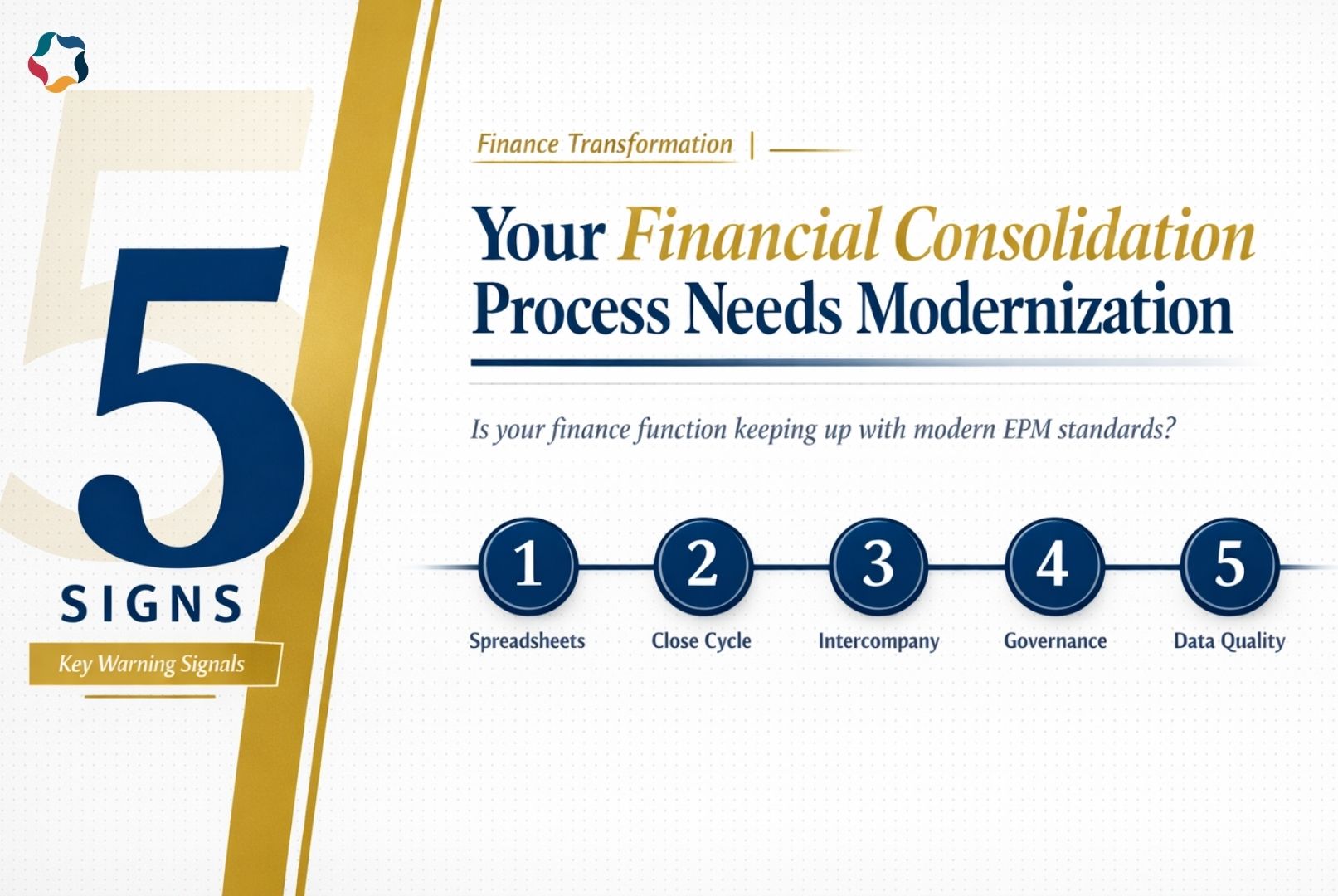
5 Signs Your Financial Consolidation Process Needs Modernization
Key Points
Introduction
If your financial consolidation process still relies on spreadsheets, manual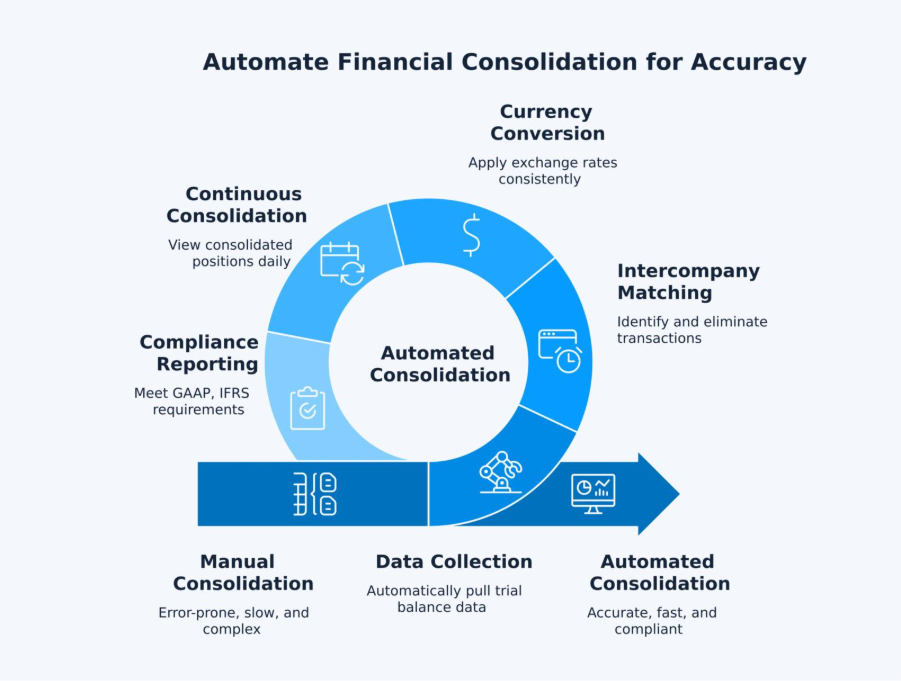 reconciliations, and fragmented tools, modernization is no longer optional—it’s overdue. From my experience working with enterprise EPM environments, the biggest risk isn’t inefficiency; it’s the inability of finance teams to deliver accurate, timely insights when leadership needs them.
A modern financial consolidation process should provide speed, transparency, and strong governance. When those elements are missing, the symptoms quickly appear in the close cycle, reporting accuracy, and financial controls. Here are five clear signals that your financial consolidation process needs modernization.
When Consolidation Depends on Spreadsheets, Control Is Already Compromised
If spreadsheets remain the backbone of your financial consolidation process, maintaining data control becomes extremely difficult.
Spreadsheets may appear flexible, but that flexibility introduces governance risks. Multiple versions circulate across teams, formulas are difficult to audit, and adjustments often occur without proper documentation. In large organizations with multiple entities, even a small formula error can distort consolidated financial results.
A modern financial consolidation process centralizes calculations, standardizes consolidation rules, and ensures every adjustment is traceable. Without a system-driven consolidation framework, finance teams spend more time validating numbers than analyzing them.
Once consolidation logic lives outside a controlled platform, transparency and consistency inevitably suffer.
When the Close Cycle Takes Too Long, Finance Is Always Behind
A lengthy close cycle is another clear indicator that the financial consolidation process requires modernization.
In many organizations, consolidation still takes weeks because data arrives from multiple subsidiaries in different formats. Currency translation, intercompany eliminations, and ownership calculations often require manual processing.
By the time consolidated results are finalized, the business has already moved forward.
A modern financial consolidation process automates critical steps such as currency translation, eliminations, and validation checks. Automation shortens the close cycle and allows finance teams to shift their focus from mechanical tasks to strategic analysis.
If consolidation consumes most of the reporting timeline, finance will always be reacting to past performance rather than shaping future decisions.
When Intercompany Reconciliation Becomes a Monthly Crisis
Intercompany transactions often expose the weaknesses of a legacy financial consolidation process.
Global organizations generate thousands of transactions between subsidiaries each month. When these transactions are not aligned across entities, reconciliation becomes a time-consuming exercise during the close cycle.
In outdated environments, finance teams rely on spreadsheets, emails, and manual adjustments to resolve mismatches. This creates delays, increases reconciliation workload, and reduces confidence in the final numbers.
A modern financial consolidation process enforces matching rules automatically and flags discrepancies early. Instead of discovering problems during consolidation, the system validates transactions at the point of entry.
If intercompany reconciliation consistently becomes a last-minute firefight, it’s a strong sign that consolidation architecture needs to evolve.
When Finance Cannot Explain the Numbers, Governance Is Weak
A reliable financial consolidation process must provide transparency into how financial numbers are produced.
In many legacy environments, adjustments occur across multiple systems, spreadsheets, and offline processes. When auditors or executives ask how a specific number was calculated, finance teams often struggle to provide a clear answer.
This lack of traceability creates governance and compliance risks.
A modern financial consolidation process embeds auditability directly into the system. Every adjustment, calculation, and transformation is recorded and traceable. This ensures finance teams can confidently explain and defend their financial statements.
Without that level of transparency, consolidation becomes difficult to govern at scale.
When Finance Spends More Time Fixing Data Than Analyzing It
Another warning sign is when finance teams spend most of their time correcting data issues instead of analyzing financial performance.
Data inconsistencies often occur when information arrives from multiple source systems without proper validation. Missing submissions, incorrect mappings, and currency mismatches frequently surface during consolidation.
A mature financial consolidation process prevents these issues by enforcing validation rules before consolidation begins. Data quality checks, submission controls, and workflow approvals ensure accuracy early in the process.
When validation happens upstream, consolidation becomes faster and more reliable—and finance teams regain time for strategic analysis.
Modernization Comes with Trade-Offs
Modernizing the financial consolidation process requires effort. Organizations must standardize reporting structures, align entity data models, and train finance teams on new workflows.
Implementation may temporarily disrupt existing processes, and some complex scenarios will still require manual adjustments.
However, these trade-offs are manageable. The goal of modernization is not to eliminate human judgment but to ensure that manual work happens within controlled and auditable processes.
Conclusion
An outdated financial consolidation process does more than slow down reporting—it limits the ability of finance to support strategic decision-making.
When consolidation relies on spreadsheets, takes too long, lacks transparency, and requires constant manual corrections, the system is no longer aligned with modern enterprise requirements.
For CFOs, FP&A leaders, and EPM architects, modernization is not just a technology upgrade. It is a fundamental step toward building a finance function that operates with speed, control, and confidence.
Organizations that modernize their financial consolidation process gain faster close cycles, stronger governance, and better insight into performance—capabilities that finance leaders increasingly need to guide the business forward.


Darshakkumar Prajapati
Lead Engineer
Darshak is a Lead Software Development Engineer with strong expertise in OneStream, including Cube Views, Dashboards, Business Rules, and advanced reporting solutions. He has 7+ years of experience delivering scalable enterprise applications across diverse domains.Specializing in Node.js, JavaScript, Angular, and DevOps, Darshak brings robust debugging and problem-solving skills to every project. Passionate about knowledge sharing, he actively contributes insights and best practices to the broader developer community.